Family biography: how to write and pass on your family's story
How to write a family biography? Complete guide to creating your family's book, from gathering memories to printing. Methods, tips and tools.
Table of contents
- What is a family biography?
- Why write your family's biography
- Where to start: sources to gather
- How to interview your family
- Different narrative approaches
- How to structure your family book
- Tools for writing your family biography
- Comparison of approaches
- Frequently asked questions
Anne-Charlotte Triplet — sociologist and co-founder of Raconteo. She has spent three years studying how families pass their memory on, and has guided several hundred memoir books. More about her.
Every family carries a unique story. Grandparents' memories told by the fireside, yellowed photos found in an attic, anecdotes passed from generation to generation: all of this forms the most precious family heritage there is. Yet this family memory often remains oral, fragile, and ends up being lost when those who carry it are no longer here to tell it.
Writing a family biography means transforming these scattered memories into a true family narrative, a book your children, grandchildren and great-grandchildren can read, hold and pass on in turn. It means anchoring your family roots in a durable object that withstands time.
This comprehensive guide walks you step by step through creating your family book, from gathering the first memories to printing the final book.
What is a family biography?
Much more than a family tree
Many people confuse family biography and family tree. These are two very different projects. A family tree is a diagram: it lists names, dates of birth and death, family relationships. It's a genealogical biography in the strict sense, a factual inventory, useful but cold.
A family biography gives flesh to that tree. It tells the stories behind the names. It explains why your grandfather left his home village, how your parents met, what your great-grandmother went through during the war. It transforms a list of dates into a living family saga.
Difference from individual memoirs
Individual memoirs focus on a single person: their journey, reflections, perspective on life. That's what we call having your biography written. A family biography has a broader ambition: it weaves together the stories of several generations to form a coherent family chronicle.
The idea isn't to tell one person's life, but to show how everyone's stories intertwine: how one ancestor's choices influenced the lives of their descendants, how certain values were passed on (or not) across generations.
What a family biography contains
A comprehensive family history book can include:
- Origins: where the family comes from, migrations, geographical settlements. If immigration is part of your story, our article on preserving your family's immigration story offers useful guidance
- Portraits: biographies of key figures (grandparents, parents, notable aunts and uncles)
- Founding moments: marriages, births, hardships, successes that shaped the family
- Historical context: how major events (wars, crises, progress) affected the family
- Traditions: recipes, expressions, rituals, trades passed from generation to generation
- Photos and documents: illustrations that anchor the narrative in reality
Why write your family's biography
Preserve memory before it's too late
This is the most urgent reason. Every year, entire chapters of family history disappear with those who were their last witnesses. Your grandmother may be the only living person who remembers the family's childhood home, the name of her father's dog, or the exact story of how your grandparents met.
Once these memories are lost, they're lost forever. Writing your grandparents' biography or your parents' biography means saving these stories while there's still time. To learn more about this urgency, read our article on how to preserve elderly people's memories.
Strengthen family bonds
The project of writing a family book is itself an act of reconnection. It pushes you to call that distant cousin you haven't seen in years, to ask your mother the questions you never dared ask, to rediscover forgotten branches of the family.
Families who embark on a family biography often find that the process (the interviews, the discussions, the research) is as precious as the final result.
Pass on a legacy to future generations
We live in an age where everything moves fast, where families are often geographically scattered. Grandchildren sometimes grow up without knowing the story of their own grandparents. A written family narrative bridges this gap.
It's an irreplaceable tool of family transmission: it gives younger generations the feeling of belonging to something larger than themselves, of being part of a continuum. Discover how to pass on your values to your grandchildren through storytelling.
Understand where you come from
Exploring your family history often brings revelations. You understand why a certain character trait appears in several family members, why certain choices were made, where certain fears or strengths come from. The family legacy isn't limited to material possessions: it includes values, resilience, talents.
Writing your family biography is also a way to better understand yourself.
Give an invaluable gift
A family book makes an extraordinary gift: for a milestone birthday, a family celebration, Christmas, or simply for the pleasure of passing things on. It's a gift that gains value over time, unlike most objects.
Where to start: sources to gather
Family photos
This is often the most natural starting point. Photo albums, shoeboxes full of prints, forgotten slides in a cupboard: all of this forms the visual raw material of your family biography.
Practical tips:
- Start by identifying the photos: who, when, where? Note the information on the back or in a file
- Scan fragile photos (a smartphone is enough to start)
- Don't aim for completeness: select photos that tell a story
- Ask each branch of the family to share their own albums
Official documents
Birth certificates, family record books, military service books, diplomas, work contracts, notarial deeds: these documents form the factual backbone of your family chronicle. Our guide on how to organise family memories can help you sort and archive everything you gather. They help verify dates, places, key events.
To supplement your research, online departmental archives are a gold mine. Most now offer digitized registers accessible for free.
Objects and material memories
Some objects tell stories all by themselves: grandfather's watch, the wedding coffee set, grandmother's hand-annotated cookbook, yellowed love letters. Identify these objects and collect the story that goes with them.
Oral testimonies
This is the richest source, and the most urgent to collect. The memories your loved ones carry in their minds are irreplaceable. It's the heart of your family narrative, the element that transforms facts into a living story.
Complementary research
To enrich your genealogical biography, you can cross-reference testimonies with:
- Local archives (period newspapers, parish registers)
- Online genealogy sites (Ancestry, FamilySearch, MyHeritage)
- Local history books
- Regional memory associations
How to interview your family
The interview is the keystone of a good family biography. It's the moment when memories emerge, forgotten anecdotes resurface, and emotion gives depth to the narrative. But interviewing your loved ones requires some method.
Preparing the interview
Choose the right moment. Favour a calm moment, with no time pressure. Avoid large family gatherings where the person will be distracted. A one-on-one in a familiar setting (at their home, in their living room) is ideal.
Prepare your questions. Don't show up without a thread. Prepare a list of themes and open-ended questions that invite storytelling, not closed questions that call for a yes or no. Our guide 50 questions for an autobiography is an excellent starting point.
Give advance notice. Tell them about the project beforehand. This lets them gather their thoughts, perhaps retrieve certain memories or photos. Present the project as a gift, not an interrogation.
Conducting the interview
Start with the easy stuff. Begin with simple, concrete questions: "Where did you live as a child?", "What was your first teacher's name?". These specific questions help dive into memories without intimidating.
Listen, don't direct. Let the person follow their train of thought. If they veer away from your question, don't cut them off: digressions often contain the best anecdotes. Your role is to prompt, not to control.
Ask sensory questions. "What did the house look like?", "What smell comes back when you think of your mother's kitchen?", "What sounds did you hear in the morning?". These questions bring buried memories to the surface and produce a vivid narrative.
Record if possible. With the person's consent, record the interview. An audio recording captures tone, hesitations, laughter, precious elements for transcription. The smartphone voice recorder is more than sufficient.
For more on this topic, read our dedicated article: how to interview your grandparents.
After the interview
- Transcribe key elements while they're fresh in your mind
- Note leads to pursue, people to contact, documents to look for
- Send a summary to the interviewee for validation and additions
- Plan a second interview if needed: memories trigger memories
Different narrative approaches
There's no single way to write a family biography. The choice of approach depends on your material, your preferences and the message you want to convey.
The chronological approach
The most classic. You tell your family history in time order, from the most distant origins to today. It's the most natural approach for the reader, who follows the thread of time like a novel.
Advantages: easy to follow, shows the family's evolution, allows events to be placed in their historical context.
Disadvantages: can become monotonous if the narrative is too linear, difficult when information about earlier periods is scarce.
Ideal for: families with a long, documented history, projects covering several generations.
The thematic approach
Instead of following chronology, you organize the narrative around major themes: the family's trades, places of life, hardships faced, love stories, traditions, values passed on.
Advantages: creates links between generations, gives depth to the narrative, avoids chronological gaps.
Disadvantages: the reader may lose the temporal thread, requires more structuring work.
Ideal for: families whose history is marked by strong themes (a trade passed down, a region of origin, a shared passion).
The character approach
Each chapter is devoted to a family member, a full portrait that tells their life, their character, their contribution to the family saga. It's the approach closest to a classic parents' biography or grandparents' biography, but extended to the entire family.
Advantages: each member gets their moment in the spotlight, allows rich and nuanced portraits, easy to structure.
Disadvantages: risk of repetition between chapters, may lack an overall thread.
Ideal for: families with strong personalities and varied paths.
The mixed approach
In practice, most good family biographies combine all three approaches. An overall chronological framework, thematic chapters for cross-cutting subjects, and portraits inserted where they contribute most.
How to structure your family book
A good structure makes the difference between a confusing text and a family book that's a pleasure to read. Here's a plan model that works for most family biography projects:
Introduction (5-10 pages)
- Why this book was written
- How it was created (sources, interviews, research)
- A note on narrative choices
- Possibly, a simplified family tree to identify the characters
Part 1: Origins (15-30 pages)
- Where the family comes from: geography, social background, historical context
- The most distant ancestors known
- Migrations, settlements
- The world in which these ancestors lived
Part 2: The founders (20-40 pages)
- Grandparents or great-grandparents: their lives, their choices
- Building the family as we know it
- Major events that marked this generation
Part 3: The pivotal generation (20-40 pages)
- Parents: their childhood, their meeting, establishing the household
- The challenges of their era: war, reconstruction, modernization
- Raising children, values passed on
Part 4: Today and tomorrow (10-20 pages)
- The family as it is today
- Traditions that endure
- Messages for future generations
- A conclusion that opens toward the future
Appendices
- Complete family tree
- Timeline of key events
- Name index
- Sources consulted
- Supplementary photo album
Formatting tips
- Photos: integrate them throughout the text, not in a block at the end. A photo in the right place is worth a thousand words
- Sidebars: use them for anecdotes, family recipes, notable quotes
- Maps: a simple plan showing the family's places of residence helps the reader find their bearings
- Cover: choose an emblematic photo that captures the family's spirit
Tools for writing your family biography
Manual writing
The most traditional method: you take up your pen (or keyboard), conduct interviews, write, structure. It's a demanding but deeply rewarding project.
For whom? Those who enjoy writing, have time, and want total control over the narrative. If you're looking for tips on writing yourself, our complete guide to writing your family history will be very useful.
Estimated duration: 6 months to 2 years.
Budget: low (printing cost only, €50-200 depending on format).
Hiring a professional biographer
A family biographer is a specialized writer who conducts interviews, carries out research and writes the book for you. It's the most comfortable solution, but also the most expensive.
For whom? Those who want a professional result without investing their own writing time. To learn more, read our article on having your biography written.
Estimated duration: 6 to 12 months.
Budget: €3,000 to €8,000 for a complete book.
Raconteo: the AI-guided family biography
Raconteo offers an intermediate approach combining the best of both worlds. The platform guides you through a structured path of thematic questions. You answer (orally or in writing) and artificial intelligence transforms your answers into written narratives, in a natural storytelling style.
For whom? Those who want to write their family biography without knowing how to write, without spending months, and without a biographer's budget. It's the ideal tool for families who want to involve every member: each person can answer questions at their own pace, from home.
How it works:
- You create an account and choose the themes that match your family history
- You answer guided questions, by typing or dictating your memories
- The AI writes a fluid, personal narrative from your answers
- You reread, adjust, complete
- You compose your book and have it printed
You can also invite your loved ones to contribute: your parents, siblings, children. Each adds their voice to the collective family narrative.
Estimated duration: 2 to 8 weeks.
Budget: €89for the complete plan. See pricing.
Raconteo also makes an excellent gift: give a parent or grandparent the chance to tell their story.
Comparison of approaches
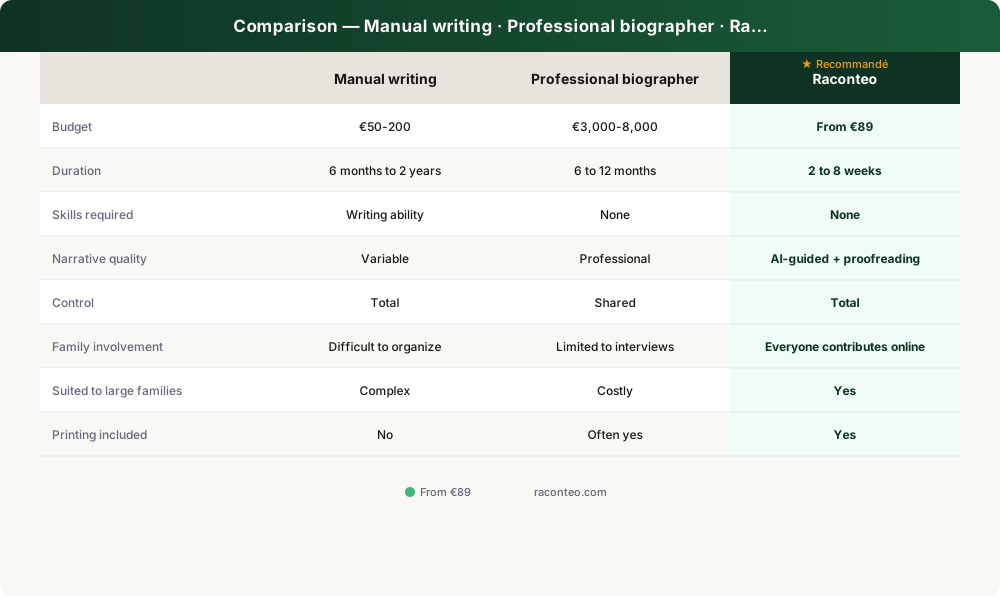
| Criterion | Manual writing | Professional biographer | Raconteo |
|---|---|---|---|
| Budget | €50-200 (printing) | €3,000-8,000 | €89 |
| Duration | 6 months to 2 years | 6 to 12 months | 2 to 8 weeks |
| Skills required | Writing ability | None | None |
| Narrative quality | Variable | Professional | AI-guided + proofreading |
| Control | Total | Shared | Total |
| Family involvement | Difficult to organize | Limited to interviews | Everyone contributes online |
| Suited to large families | Complex | Costly (multiply interviews) | Yes (unlimited invitations) |
| Printing included | No | Often yes | Yes |
Frequently asked questions
How long does it take to write a family biography?
It depends entirely on the approach chosen and the project's scope. Manual writing takes between 6 months and 2 years for a complete result. With a professional biographer, the process typically lasts 6 to 12 months. With a guided platform like Raconteo, you can have a family book ready to print in 2 to 8 weeks.
The essential thing is to get started. Even a modest project (a few chapters about your grandparents) is better than no project at all. You can always enrich it later.
Do I need to know how to write to create a family biography?
No. Of course, if you have a natural gift for writing, the project will flow more smoothly. But what matters in a family biography isn't literary style but the content. It's the memories, the anecdotes, the emotions that count.
With Raconteo, this barrier disappears completely: you tell your memories orally or in writing, and the AI handles the writing. You retain total control over the content, without having to worry about form.
How do you handle sensitive topics in a family history?
Every family has its shadows: divorces, conflicts, secrets, painful ordeals. It's not necessary to tell everything, but completely ignoring difficulties makes the narrative artificial.
A few principles: respect the wishes of the people concerned (don't publish anything that could hurt a living person without their consent), stay factual about sensitive subjects without passing judgment, and don't hesitate to mention that a subject exists without going into detail. "This was a difficult period for the family" is sometimes enough.
How much does a family biography cost?
Costs vary enormously depending on the approach. Manual writing only costs printing (€50-200). A professional biographer charges between €3,000 and €8,000. Raconteo offers a complete plan €89, including the creation platform and the option to print the book.
Cost should never be a barrier to this family transmission project. Whatever your budget, there's a suitable solution. Check our pricing for more details.
Can you involve the whole family in the project?
It's even recommended. A family biography is all the richer for integrating multiple viewpoints. The same event told by your father and your aunt will produce two different stories, and it's this polyphony that makes a family saga rich.
With Raconteo, each family member can contribute remotely, at their own pace. You can also check our FAQ to understand how collaboration works.
Which family member should you start with?
Start with the oldest. It's common sense and urgency: they hold the oldest memories, the rarest, the most at risk. Your 85-year-old grandmother is an irreplaceable source, and your parents will still have time to tell their story in a few years.
Also start with the most talkative people, those who love to tell stories. Their enthusiasm will be contagious and give momentum to the project. To help you, discover our 50 questions for an autobiography.
Get started: your family has a story that deserves to be told
Every family is unique. Every family history deserves to be preserved. And every day that passes without capturing it is a day of potentially lost memories.
You don't need to be a writer. You don't need a famous family. You don't need to trace back to the Middle Ages. All it takes is a voice that tells, ears that listen, and a tool that transforms these memories into lasting family heritage.
With Raconteo, create the family biography your grandchildren will read in 50 years.