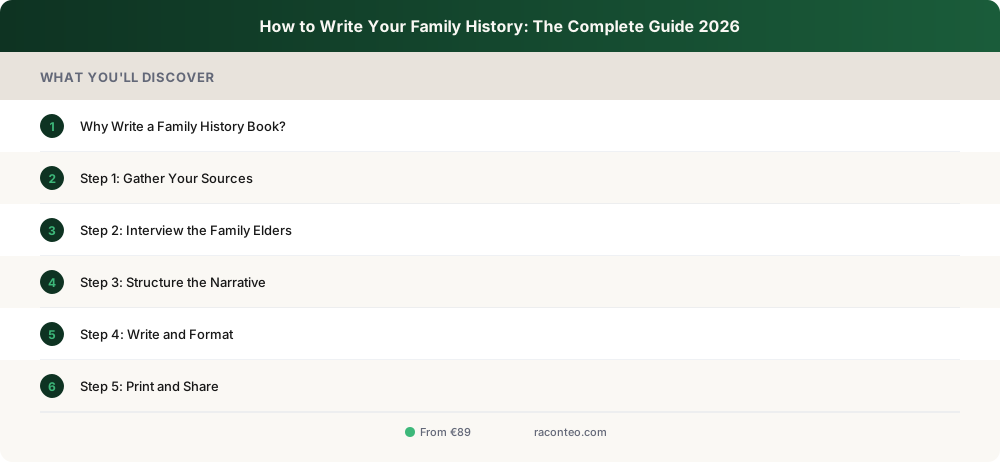
How to Write Your Family History: The Complete Guide 2026
A step-by-step method to write your family history: sources, interviews, structure and layout for a book that stays in the family.
Every family carries an extraordinary story within it. But without a conscious effort to preserve it, that story fades away, with each grandparent who passes, each house move, each box of photos forgotten in the attic.
Writing your family history means capturing those memories in a book that will endure for decades. Here is how to go about it, step by step.

Anne-Charlotte Triplet — sociologist and co-founder of Raconteo. She has spent three years studying how families pass their memory on, and has guided several hundred memoir books. More about her.
Why Write a Family History Book?
Preserve the Memory Before It Is Too Late
Studies show that family memory survives on average only three generations without a written record. Your great-grandchildren will probably not know your grandparents' first names, unless someone takes the time to write them down.
Strengthen Bonds Between Generations
A family book project brings people together. It gives young people a reason to question their elders, and gives the elders pride in passing on their legacy. It is a bridge between ages.
Give a Priceless Gift
Unlike material objects, a family history book grows in value over time. In 50 years, it will be the most precious possession your family owns. For guidance on turning that history into a lasting family legacy, read our article on how to leave a family legacy.
Step 1: Gather Your Sources
Before writing a single word, collect everything that already exists:
- Old photographs: Scan them, note the dates and the people identified on the back
- Official documents: Family record books, birth certificates, diplomas, letters
- Family trees: Websites such as Ancestry, MyHeritage or FamilySearch can complement your research. If your family has immigrant origins, our article on preserving your family's immigration story will be particularly useful
- Family heirlooms: A grandfather's watch, a wedding dress, a trade tool... every object tells a story
- Press cuttings: Local newspaper articles mentioning your family
Tip: Create a shared digital folder (Google Drive, Dropbox) where each family member can deposit their finds. For a structured approach to sorting everything you collect, see our guide on how to organise family memories.
Step 2: Interview the Family Elders
This is the most precious step, and the most urgent. First-hand witnesses are irreplaceable.
The Right Questions to Ask
Do not simply say "Tell me about your life." Ask specific questions that trigger memories:
- "What was your childhood home like? Describe every room for me."
- "What was your father's trade? How did he choose it?"
- "What is the funniest moment you ever experienced as a family?"
- "How did you meet Grandma/Grandpa?"
- "What was the hardest trial of your life?"
Tips for a Successful Interview
- Record rather than take notes: speaking is more natural for elderly people
- One question at a time: Allow time to answer; silences are precious
- Several short sessions rather than a marathon: 30 to 45 minutes is ideal
- Ask the most important questions first: You never know how much time you have
Step 3: Structure the Narrative
Option 1: Chronological
From the grandparents' birth to the present day. Simple and intuitive, but can become monotonous.
Option 2: By Themes
Childhood, love, careers, travels, hardships, traditions. More lively and allows you to weave generations together.
Option 3: By Character
Each chapter follows one family member. Ideal for large families.
Our advice: The thematic approach works best. It lets you compare eras and creates natural bridges between generations.
Step 4: Write and Format
Write Simply
The number one pitfall is trying to write like a novelist. Your family wants to hear your voice, not that of Shakespeare. Write as you speak: with authenticity.
Include Visual Elements
- Period photographs with captions
- Reproductions of documents (letters, postcards)
- An illustrated family tree
- Maps of important places
Pay Attention to Layout
A family book deserves professional layout. Choose legible fonts, generous margins, and alternate between text and images.
Step 5: Print and Share
A PDF on a screen does not carry the same weight as a bound book that you can hold, leaf through and pass on. Have several copies printed, one for each branch of the family.
The Raconteo Solution: Write Your Family History Effortlessly
The entire process can feel daunting. That is precisely why Raconteo exists.
Our platform guides each family member through carefully crafted themed questions. Answer by voice or in writing, and our AI transforms your responses into structured, moving narratives.
No blank page. No stress. Just your memories, beautifully told.
What Raconteo Does for You:
- ✅ Guided questions by theme (childhood, love, career, values...)
- ✅ Voice recording: speak, and the AI writes
- ✅ Automatic professional layout
- ✅ Library-quality printing and binding
- ✅ Family collaboration: invite your loved ones to contribute
Frequently Asked Questions
How long does it take to write a family history?
With a traditional method, expect 6 to 12 months. With Raconteo, a few minutes per week is enough, since the AI handles the writing.
Do I need writing skills to create a family book?
No. With Raconteo, you can answer questions by voice. The AI transforms your words into structured text.
How much does it cost to print a family book?
Prices range from €30 to €200 depending on format and page count. Raconteo charges a one-off €89, which includes unlimited AI creation.