Preserving Your Family's Immigration Story: Why and How to Capture This Unique Heritage
How to collect and pass on your family's immigration story? Practical methods and tools to make sure this irreplaceable memory is never lost.
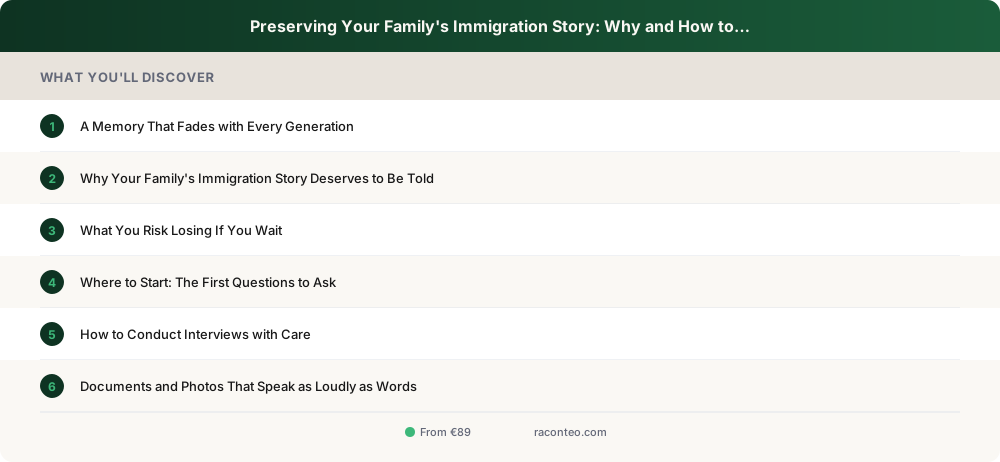
Table of Contents
- A Memory That Fades with Every Generation
- Why Your Family's Immigration Story Deserves to Be Told
- What You Risk Losing If You Wait
- Where to Start: The First Questions to Ask
- How to Conduct Interviews with Care
- Documents and Photos That Speak as Loudly as Words
- The Raconteo Solution for Preserving This Story
- Frequently Asked Questions

Anne-Charlotte Triplet — sociologist and co-founder of Raconteo. She has spent three years studying how families pass their memory on, and has guided several hundred memoir books. More about her.
Some stories have never been properly asked for. The story of your grandfather who left his village at 22 with a cardboard suitcase and a few banknotes sewn into the lining of his jacket. The story of your grandmother who didn't speak a word of the language when she arrived, who learned new words by staring at shop windows and smiling at neighbours who didn't always smile back.
These stories live in the memory of those who lived them. And one day, sometimes without warning, that memory goes dark.
Preserving your family's immigration story is one of the most powerful acts of transmission any generation can perform for those that follow.
A Memory That Fades with Every Generation
Every family with immigrant roots carries an epic story inside it. A journey. A rupture. A rebuilding. But most of the time, that epic has never been written down. It was passed on in whispers: in the kitchen, between anecdotes, half in English and half in the language of origin. It was passed on in fragments, incomplete, sometimes idealised, sometimes discreetly left unspoken.
The first generation, those who actually emigrated, holds the most precious details: the smells of the homeland, the name of the ship or train, the fear at the border, the first room in the new country, the humiliations endured and overcome, the unexpected joys. But this generation rarely speaks. They grew up in a world where there was no time to tell stories. You survived, you worked, you built.
The second generation, your parents perhaps, grew up between two cultures without always having the language to describe it. They may have felt ashamed of a difficult past, or conversely glorified it without knowing the details. They have fragments, impressions, a few yellowed photographs.
The third generation (you, perhaps, or your children) is often hungry for roots. They want to understand where they came from. But by then, the direct witnesses are often gone, or too elderly to remember clearly.
The window to collect these testimonies is narrow. And it is closing.
Why Your Family's Immigration Story Deserves to Be Told
A Story That Belongs to You
Your family's immigration story is a fundamental part of your identity. Understanding the sacrifices that were made (ties severed, a homeland abandoned, hopes pinned on a foreign country) changes profoundly how you see yourself and how you regard those who came before you.
When you know that your grandfather spent years working on a building site so his children could go to university, you carry that fact differently. It is no longer an abstraction: it is a story.
A Resource for Your Children and Grandchildren
Children who grow up knowing their family's story, even the hard parts, develop a stronger sense of belonging and continuity. Research in family psychology confirms it: having a strong "family narrative" is one of the best predictors of emotional resilience in children.
Knowing that a great-grandmother crossed a war zone, rebuilt herself in a new country, and kept going gives children a sense of pride and inner strength that goes beyond words.
An Intimate Duty of Memory
On the scale of collective history, the migrations of the twentieth century represent one of humanity's great epics. Every immigrant family carries a fragment of that history. Not collecting it means letting a piece of collective memory disappear.
What You Risk Losing If You Wait
If you are reading this, there is probably still someone in your family who remembers. A grandparent. A great-aunt or great-uncle. A parent who carries half-remembered details no one else knows.
What you risk losing if you wait:
- Names: the name of the village of origin, the street, the people who stayed behind
- Dates: exactly when, under what circumstances, what event triggered the departure
- Emotions: the fear, the hope, the shame, the pride, all the inner states that cannot be guessed from the outside
- Concrete details: what was in the suitcase, what was left behind, the first meal eaten in the new country
- The unspoken: traumas that were buried, losses that were never mourned, regrets that were never voiced
None of this can be found in any archive. It exists only in the living memory of witnesses.
Where to Start: The First Questions to Ask
Starting a conversation about immigration is not always easy. Many elderly people have internalised the idea that their story is not worth telling, that it is "ordinary", that no one is interested.
Your first job is to convince them otherwise. The best way to do that is to ask simple, concrete, sensory questions, not grand abstract questions about "the meaning of the journey".
Questions to Get Started
About the departure:
- What was the name of your village, city, or neighbourhood before you left?
- How old were you when you decided to leave, or when someone decided for you?
- What did you pack in your bags? What did you leave behind?
- Do you remember the exact moment when you understood you might not come back for a long time?
About the journey:
- How was the journey? How long did it take?
- Were there other people you knew travelling with you?
- Were you afraid? What gave you courage?
About the first days:
- What is your first memory in the new country?
- How did you find your first home? Your first job?
- How did people receive you? Was there warmth? Suspicion?
- When did you learn the language? How?
About ties kept with the home country:
- Did you write letters? Make phone calls? How did you stay in touch?
- Were there moments when you wanted to stop everything and go home?
- Were you ever able to go back? What did you feel when you saw the country again?
How to Conduct Interviews with Care
Creating a Safe Space
Choose a quiet moment: no ringing phones, no children running around. Offer to come to your relative's home; they'll feel more comfortable on their own turf. Bring something warm, a coffee, a tea, a pastry.
Don't launch straight into questions. Start with lighter conversation. Let the story come naturally. The best memories often emerge on the margins, not from direct questions.
Listen More Than You Speak
Resist the urge to complete sentences, add your own memories, or correct inaccuracies. Your role is to listen and prompt, not to comment. A silence is an invitation to continue. Learn not to fill it too quickly.
Handling Difficult Moments
Some subjects can bring up painful emotions: grief for those left behind, humiliations endured, dreams that never came true. Never force it. Respect the silences and the "I'd rather not talk about that". The goal is not to extract all the information. It is to create a space where the person feels free to share what they choose to share.
Recording with Permission
Always ask before turning on a recorder or filming. Some people freeze the moment they know they are being recorded. In that case, take handwritten notes and transcribe them as soon as possible after the conversation, while the details are still fresh.
You might also consider several short conversations rather than one long session. Memory works in layers: a first conversation opens doors, and the second is often richer than the first.
Documents and Photos That Speak as Loudly as Words
Visual and documentary archives are extraordinary triggers for memory. Before your conversations, gather everything you can find:
Official Documents
- Old passports and identity documents
- Residence permits, work cards
- Birth certificates, marriage certificates from the country of origin
- Letters and correspondence (even in another language)
- Old payslips, employment contracts
Photographs
Family photographs are memory catalysts. Show them to your relative and ask simple questions: "Who is this person?", "Where was this?", "Do you remember that day?" A wedding photo, a group portrait in a workshop, a simple image of a modest apartment, each image can unlock memories buried for decades.
Objects
Immigration often leaves material traces: an old suitcase, a rosary, a craftsman's tool, an embroidered tablecloth brought from home. These objects have stories. Ask for them.
Organising and Digitising
Once you have gathered the documents, digitise them. Photographs yellow and deteriorate. Letters become fragile. A good scanner or even a recent smartphone is enough. File everything by date and event. Create a shared folder accessible to the whole family.
The Raconteo Solution for Preserving This Story
You have the questions. You may have already had the first conversations. But how do you transform all of this into something lasting, beautiful, and transmissible?
That is exactly what Raconteo was built for.
Raconteo is a platform that guides elderly people, or their relatives, through structured questions organised by life themes. Using artificial intelligence, the answers are shaped into flowing, emotionally resonant narratives that can then be compiled into a printed biographical book or shared as a digital document.
For an immigration story, the process is particularly well-suited:
- Structured questions: Raconteo offers questions covering childhood in the country of origin, the departure, the journey, arrival, integration, sacrifices, and victories, all the essential chapters of a migration story
- Gentle guidance: the questions are written so that even someone unused to talking about their life feels comfortable and valued
- Professional formatting: the AI shapes the answers into coherent narrative text, with the connective phrases, descriptions, and emotional colour that make a story truly readable
- A printed book: the result can become a bound book, with family photographs, that every member of the family can receive and keep
The book becomes a tangible family legacy, something your grandchildren will read in fifty years to understand where they come from.
Frequently Asked Questions
What if my grandparent barely speaks English?
No problem. Raconteo works in multiple languages. You can also act as an intermediary: conduct the interview in the language of origin, take notes, then work them through the tool. The essential thing is to collect the testimony. Language is a technical detail that can be solved.
What if my grandparent doesn't want to talk about the past?
This is common, especially with people who have lived through traumatic experiences. Don't force it. Start with positive memories: a village celebration, a dish they used to cook, a trade they learned. Trust builds over time. Often it is after the second or third conversation that the doors truly open.
What if the direct witnesses have already passed away?
Other avenues exist. The testimonies of children (your parents) who grew up during the early years of immigration are valuable. National and regional archives sometimes hold data on migration flows. Oral history associations and immigration museums can also help you contextualise what you already know.
Does it take any special training to write an immigration biography?
None at all. You are not a journalist or a historian, and that is a strength, not a weakness. You are a family member. Your empathy, your intimate knowledge of the family, your ability to ask the right questions in the right atmosphere are worth far more than any interview technique. Tools like Raconteo handle the formatting for you.
How do you share the final story with the whole family?
The printed book remains the most universal solution: no account, app, or screen required. It can be given to every family member at a birthday, a meal, a special occasion. Some families organise a "reading evening" where they discover the book together, often a deeply moving experience.
How long does the process take?
With Raconteo, the process is gradual: your relative answers at their own pace, in multiple short sessions. No need to do everything at once. The platform saves answers and lets you pick up where you left off. Within a few weeks of regular sessions, you can have enough material for a beautiful book.
Your family's immigration story is a treasure. It deserves to be told, written down, and passed on. Every day that passes without collecting it is a day on which it fades a little more.
Start today. One question. A cup of tea. A conversation.
Start preserving your family's story with Raconteo