Memoirs and Genealogy: How to Combine Both for a Complete Family Legacy (2026)
How to combine memoirs and genealogy to create a complete family legacy? A practical guide to telling your ancestors' stories and building a family book.
Your family tree shows that your great-grandfather was a blacksmith in Lyon in 1880. But who was he really? How did he live? What drove him to leave his village for the city? Genealogy gives you names and dates. Memoirs give you the soul. Combined, they create something far more powerful: a living family legacy that your grandchildren can read and cherish.
This guide explains how to marry genealogy and memoirs to build a complete family book.
Table of Contents
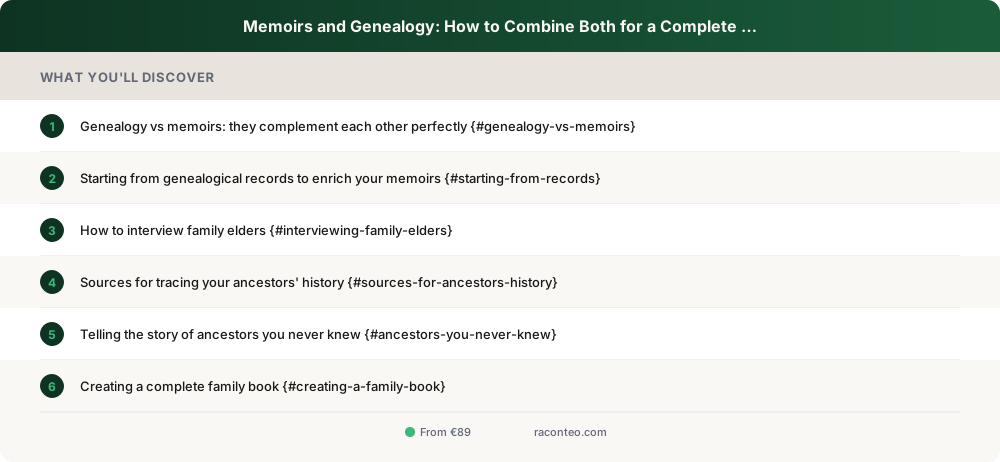
- Genealogy vs memoirs: they complement each other
- Starting from genealogical records
- How to interview family elders
- Sources for tracing your ancestors' history
- Telling the story of ancestors you never knew
- Creating a complete family book
- Table: genealogical information sources
- Frequently asked questions
Anne-Charlotte Triplet — sociologist and co-founder of Raconteo. She has spent three years studying how families pass their memory on, and has guided several hundred memoir books. More about her.
Genealogy vs memoirs: they complement each other perfectly
Genealogy is a science: it reconstructs family connections, finds civil records, traces migrations. But it often remains cold: names, dates, places. It tells you who came before you, but not how those people lived.
Memoirs, on the other hand, are human warmth: emotions, anecdotes, lived experiences. But they start from yourself and rarely go further back than your grandparents.
Combining the two gives you the best of both worlds: the factual precision of genealogy + the inner life of memoirs. The result? A book where the names on the family tree become characters, and where your own life gains meaning within the continuity of a larger family story.
To go further on family history, also read our guide on how to write your family history and our article on family biography.
Starting from genealogical records to enrich your memoirs
If you've already started some genealogical research, even basic, you have a gold mine in your hands. Every name, every place, every date can become the starting point of a story.
Practical method:
- Take your family tree (even if it's incomplete).
- For each person you have information about, note what you know about their life, and what you don't know.
- The gaps are precious: they become the questions to ask your elders, to search for in the archives.
- Cross-reference the dates with historical context. Your great-grandmother was 20 during World War II? That era becomes a chapter in its own right.
How to interview family elders
Direct witnesses (grandparents, great-grandparents, elderly uncles and aunts) are your most precious sources. And time is pressing: every passing year takes away irreplaceable memories.
How to prepare the interview:
- Choose a calm, comfortable moment with no time pressure.
- Bring old photos: they trigger memories like nothing else.
- Ask open-ended questions: "What was your house like when you were a child?", "What do you remember about your father?", "What made you decide to emigrate?"
- Record with their permission (phone placed on the table). You won't be able to write everything down in real time.
- Don't correct, don't interrupt. Let the digressions come, that's often where the gems are hidden.
For question ideas, check out our article on autobiography question ideas.
Sources for tracing your ancestors' history
When there are no more living witnesses, archives take over. There are more sources available than you might think.
Civil records: births, marriages, deaths since 1792 in France. Available at the Departmental Archives, often online.
Parish records: before 1792, parish registers contain baptisms, marriages, and burials. Available at the National or Departmental Archives.
Military archives: for ancestors who served in wars, conscription files, medals, and military service records are invaluable.
Photos and letters: search the attics, the old shoeboxes. A photo with a note on the back, a letter from 1917 sent from the front. These are priceless treasures.
Genealogy platforms: Ancestry, Geneanet, MyHeritage let you cross-reference your research with that of other families. Sometimes, a stranger has already done the work.
Telling the story of ancestors you never knew
You have no personal memories of your great-grandfather who died in 1920. How do you bring him to life in your book?
Documented fiction: Based on the facts you know (birthplace, profession, era), you can plausibly imagine their daily life. This isn't inventing. It's contextualizing. "In 1910, a Lyon blacksmith would wake up at five in the morning…"
Historical context as narrative: Tell the story of the era. If your great-grandfather lived through the 1870 war, describe what a man of his age, in his region, experienced during that period. His individual life gains meaning within this collective framework.
Family testimonies: Perhaps your grandmother spoke to him? Did an uncle keep an anecdote? These fragments are worth gold.
Honestly stating what you don't know: There's no shame in writing "I don't know much about him, but here's what I was able to find…" Honesty strengthens the credibility of the story.
You can also draw inspiration from our article on your family's immigration story if your ancestors crossed borders.
Creating a complete family book
A complete family book can combine:
- A genealogical section (tree, profiles by generation)
- Biographical chapters on the most memorable ancestors
- Your own memoirs
- Captioned photos
- Scanned original documents (certificates, letters, postcards)
Structural advice: Organize by generation, from the oldest to the most recent. Each generation deserves at least a double page: some factual data + a life story, even a brief one.
What matters isn't perfection. It's that the book exists. In 30 years, your grandchildren will be infinitely grateful that you left them this record.
Raconteo lets you gather your stories, add photos, and create a printed book or PDF. It's the simplest way to turn years of memoirs and research into a tangible, lasting keepsake.
Table: genealogical information sources
| Source | Type of Information | Period Covered | Access |
|---|---|---|---|
| Civil records | Births, marriages, deaths | Since 1792 | Departmental archives, online |
| Parish records | Baptisms, marriages, burials | Before 1792 | National/departmental archives |
| Military archives | Military service, wars | 19th-20th century | SHD Vincennes, online |
| Photos & letters | Daily life, emotions | Variable | Family attics |
| Ancestry / Geneanet | Trees, shared documents | Variable | Online (subscription) |
| Oral testimonies | Anecdotes, atmosphere, details | Living memory | Family elders |
Frequently asked questions
Do I need to be a genealogy expert to get started? No. Even an incomplete tree is enough to begin. What matters is having a few anchor points (names, places, dates) to build a story around.
What if the archives are inaccessible or destroyed? Some archives have burned (notably in 1871 in Paris). In that case, rely on oral testimonies, photos, and historical context. The absence of documents doesn't prevent you from telling the story.
Can I include ancestors I'm not very proud of? Yes. Honesty gives depth to the family story. You can tell without judging, or explain the context that sheds light on choices that seem incomprehensible today.
How can I involve children and grandchildren in the process? Share your discoveries as you go. Ask them what they'd like to know about the family. Some will be more passionate than you'd expect.
How long does it take to create a family book? It depends on the depth of your research. With Raconteo, writing is made easier through guided questions: you can have a first book in just a few weeks.
Start your family legacy with Raconteo
Your ancestors deserve to exist beyond a line on a family tree. Your own memories deserve to be passed on. Raconteo helps you weave the two into a book that the whole family will treasure.