Questions to Ask Your Parents Before It's Too Late: 50 Essential Questions (2026)
Don't let your parents' story disappear. Here are 50 essential questions to ask your parents or grandparents before it's too late, to preserve their memory.
Table of Contents
- The urgency of asking these questions
- Creating a warm setting for the interview
- 50 essential questions by category
- How to record and organize the answers
- Turning these answers into a gift book
- Formats for preserving the answers
- Frequently asked questions

Anne-Charlotte Triplet — sociologist and co-founder of Raconteo. She has spent three years studying how families pass their memory on, and has guided several hundred memoir books. More about her.
Your mother once told you the story of how she met your father. Your grandfather sometimes mentions his youth in the countryside, before the war. You know these fragments of family history, but have you truly collected them, written them down, preserved them? Every passing day erases a little more of these irreplaceable stories. It's not too late, but you need to act now.
The Urgency of Asking These Questions
An American study reveals that one in two adults has never truly asked their parents about their past. We always put it off: out of shyness, lack of time, or fear of touching on sensitive subjects. Then one day, it's too late.
Every week, families lose entire chapters of their history forever. War stories, immigration tales, young love, silent sacrifices. All of it disappears with the person who carries them. No genealogical research, no archival photo can ever reconstruct what only your parents know.
The good news: all it takes is asking the right questions. And doing it now.
Creating a Warm Setting for the Interview
Before pulling out your list of questions, take the time to set the stage. A forced or clumsy conversation may close up rather than open up.
Choose the right moment. After a good meal, during a walk, or on a quiet afternoon with no busy schedule. Avoid times of stress or tiredness.
Pick a familiar place. The family kitchen, the garden, the living room: places full of memories naturally loosen the tongue.
Ask permission to record. A simple smartphone placed discreetly on the table is all you need. Explain that it's so you don't forget anything, not to broadcast it.
Adopt an active listening posture. Don't interrupt, don't correct, don't compare. Let silences breathe. The most beautiful stories often come after a pause.
Start with light questions. Childhood, happy anecdotes, before broaching more intimate or painful topics.
50 Essential Questions by Category
Childhood and Family of Origin (10 Questions)
- Where and when were you born? What was that place like?
- What were your parents' names, and what did they do for a living?
- Do you have brothers or sisters? Where did you fall in the sibling order?
- What is your happiest childhood memory?
- What was your childhood home like? Describe one room in detail for me.
- What was your favorite subject at school? Your most memorable teacher?
- What games did you play? With whom?
- How did your family manage financially? Were there difficult times?
- What family traditions brought you all together?
- What historical event did you experience as a child that you still remember?
Love, Marriage, and Children (10 Questions)
- How did you meet [your spouse]? What attracted you to them?
- What was your first date like?
- How did the marriage proposal happen? Where were you?
- What memory do you keep from your wedding?
- When did you know you wanted children?
- How did you experience the birth of your first child?
- What moment with your children touched you the most?
- Is there something you regret not saying or doing for your children?
- How has love changed your life?
- What advice would you give someone starting a new relationship?
Career and Major Decisions (10 Questions)
- What was your first job? How did you find it?
- What was the turning point of your professional life?
- Did you ever have to choose between two very different paths? Which did you take and why?
- What project are you most proud of in your career?
- Did you experience periods of unemployment or uncertainty? How did you get through them?
- Is there a profession you would have liked to pursue but didn't?
- How did you support yourself as a young adult?
- Which professional decision most influenced the course of your life?
- Did you have mentors or people who truly helped you in your career?
- What has work taught you about yourself?
Difficult Times and Hardships (10 Questions)
- What is the hardest ordeal you've been through?
- How did you cope with the loss of a loved one?
- Is there a period of your life you rarely talk about, and why?
- Did you experience war, exile, or a major crisis? How did you live through it?
- What was your greatest failure? What did you learn from it?
- Have you ever feared for your life or the life of a loved one? Tell me about it.
- Is there anything you would have done differently in hindsight?
- How did you keep going during times of discouragement?
- Who supported you in your darkest moments?
- What have these hardships taught you about your own strength?
Values, Advice, and Life Wisdom (10 Questions)
- What is the most important thing in life, in your opinion?
- What value did you most want to pass on to your children?
- Is there a book, a film, or a quote that has profoundly marked you?
- What advice would you have liked to receive at age 20?
- What makes you proudest in your life?
- If you could speak again to someone who has passed, what would you say to them?
- What do you hope your children and grandchildren will remember about you?
- How do you imagine the future of our family?
- Is there a family secret you could now share?
- What would you like me to know that I've never thought to ask?
How to Record and Organize the Answers
Once the questions have been asked, the answers still need to be preserved. Here are some complementary approaches.
Audio or video recording is the most faithful method: it captures tone, emotions, laughter. A smartphone is all you need. Store the files in the cloud and share them with the family.
Handwritten notes let you jot down the essentials during the conversation, without waiting for transcription. Keep a dedicated notebook.
Transcription turns a recording into readable text. Tools like Otter.ai or Whisper do it automatically in just a few minutes.
A memoir book is the ultimate step: anecdotes organized, formatted, illustrated with photos, a tangible object that will span generations.
To go from a raw interview to a finished book, Raconteo takes care of everything: narrative structure, layout, printing.
Also discover how to interview your grandparents to round out your approach.
Turning These Answers into a Gift Book with Raconteo
Imagine giving your family a bound book that brings together your parents' entire life: their childhood stories, their loves, their hardships, their wisdom. An object your children and grandchildren will be able to hold in their hands 50 years from now.
Raconteo transforms interviews into complete memoir books. You import your recordings or notes, our AI generates a smooth and authentic narrative, you review it, and we print it as a premium hardcover book.
It's also the perfect gift for a grandparent's 80th birthday or for any occasion where you want to mark a family milestone.
To go further, read our guide on how to preserve elderly people's memories and on how to pass on your values to your grandchildren.
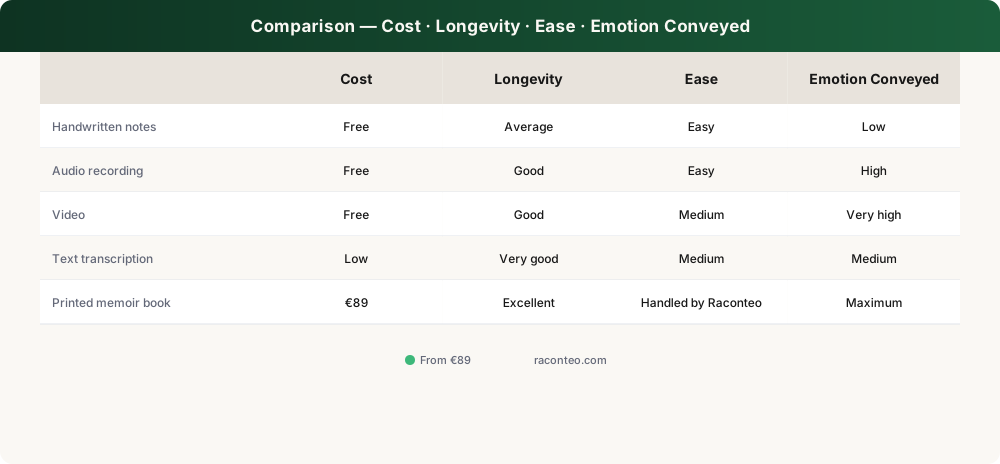
Comparison Table: Formats for Preserving the Answers
| Format | Cost | Longevity | Ease | Emotion Conveyed |
|---|---|---|---|---|
| Handwritten notes | Free | Average | Easy | Low |
| Audio recording | Free | Good | Easy | High |
| Video | Free | Good | Medium | Very high |
| Text transcription | Low | Very good | Medium | Medium |
| Printed memoir book | €89 | Excellent | Handled by Raconteo | Maximum |
Frequently Asked Questions
How do I bring up sensitive topics without hurting my parents?
Let them know in advance that some questions will be personal, and that they can always choose not to answer. Always start with happy topics. Respect and gentleness open far more doors than insistence.
My parents refuse to be recorded. What should I do?
Respect their choice and simply take notes. What matters is collecting the stories, regardless of the medium. You can also suggest they write their answers themselves at their own pace.
How long does it take to conduct a full interview?
A session of 1 to 1.5 hours is ideal to stay energized without exhausting anyone. Four light sessions are better than one marathon. Space them over several weeks to let memories surface naturally.
Can Raconteo turn recordings into a book directly?
Yes. Raconteo accepts transcriptions, notes, and audio recordings to generate a structured narrative. Our team and our AI handle all the narrative and typographic formatting.
What if my parents have memory disorders?
It's never too early to start. Even with mild impairments, many older memories remain accessible. Read our guide on memoirs and Alzheimer's for tailored advice.
Start Today, Before It's Too Late
Every story deserves to be preserved. Don't let the years erase what your parents have lived through. Ask these questions, record their answers, and turn them into a book that will outlast us all.