What to Do After Writing Your Memoirs? 5 Options to Share and Pass Them On (2026)
You've finished writing your memoirs — now what? Discover the 5 best options to print, share, publish and archive your life story for generations to come.
What to Do After Writing Your Memoirs? 5 Options to Share and Pass Them On
Table of Contents
- Congratulations: you've written your memoirs!
- Step 1: proofreading and editing
- The 5 main options after writing
- How to decide how many copies to print
- Organising the handover
- Comparison table
- Frequently asked questions
You've spent weeks, sometimes months, digging through memories, choosing your words, telling your life story. And now you hold — on screen or in your hands — your completed memoir. It's an extraordinary achievement. But one question immediately arises: what do you do with it now?
Writing your memoirs is only the first half of the journey. The second is transmission. A story that stays in a drawer or on a forgotten hard drive never fulfils its purpose: connecting generations, bearing witness, keeping a life alive in the memory of those you love.
This guide walks you through the 5 concrete options available to you after finishing your memoirs — their advantages, limitations, and how to choose the right one for your situation.
Congratulations: you've written your memoirs!
Before going further, take a moment to appreciate what you've accomplished. Writing your memoirs takes rare courage: the courage to tell your story honestly, to dive into sometimes painful memories, to decide what deserves to be passed on.
Fewer than 5% of people who think about writing their memoirs actually do it. You're one of them. That's a personal victory as much as a gift to your family.
Now the question is no longer "how to write" but "how to share". And there are far more options than most people realise.
Step 1: proofreading and editing
Before choosing how to share your memoirs, one step is essential: proofreading. Not to rewrite everything, but to correct typos, clarify confusing passages, and verify dates.
Who can proofread?
- A trusted loved one — your spouse, a child, a close friend. They know your life and can flag inconsistencies. Choose someone who will respect your voice and won't try to rewrite your style.
- A professional proofreader — for publication-quality work, an independent proofreader (£120–350 depending on length) brings orthographic and grammatical rigour that a familiar eye can't guarantee.
- Raconteo — if you used our platform, your story is already structured, AI-reviewed and ready for printing. Our process includes automatic narrative review at every step.
Once proofread and corrected, your manuscript is ready for the next step: choosing how to share it.
The 5 main options after writing
Option 1: Print a book
This is often the original dream: holding a real book in your hands with your name on it. And it's within reach.
Ways to print:
- Self-publishing platforms — services like Blurb, Lulu or Bookcreator allow on-demand printing from a PDF. Expect to pay £25–70 per copy depending on size and quality.
- A local printer — for larger runs (10 copies and up), a local printer may offer competitive rates. Get multiple quotes.
- Raconteo — our service integrates layout, personalised cover and printing in a single workflow. See our pricing. The result is a paperback or hardback book, ready to give, €89.
This is the most lasting and moving option. A physical book endures in ways no digital file can match. Also check out our complete guide on printing your memoirs as a book.
Option 2: Share digitally
If printing isn't your priority, digital sharing offers immediate, low-cost distribution.
- PDF by email — the simplest approach. Export your manuscript as a PDF and send it to loved ones. Drawbacks: emails get lost, attachments don't always open.
- USB stick — ideal for family members less comfortable with the cloud. Save your story (PDF + photos) on a USB stick and give one to each child or grandchild.
- Dropbox / Google Drive — create a shared folder accessible to the whole family. Practical for geographically dispersed families.
- Private website — platforms like StoryWorth or Memoir allow you to create a private online space to share your story with invited members.
Option 3: Give copies to family
The most natural idea: give your book to those who matter. A copy for each child, perhaps for grandchildren, for a sibling, for a close friend.
Think about personalising each copy: a handwritten dedication on the title page transforms a book into an irreplaceable treasure. Some choose to present their book at a family event — Christmas, a birthday, a family gathering — to turn the handover into a memorable moment.
For presentation ideas, check out our article on giving a memory book as an original gift.
Option 4: Deposit in family archives or a library
A little-known but precious option: depositing a copy in a preservation site.
- Regional archives sometimes welcome personal life testimonies, especially those with a historical dimension (war, immigration, a disappearing trade).
- Your local library may keep a copy in its local collection.
- A family archive box — a beautiful cardboard box containing your book, photos, and letters, entrusted to a child designated as "memory keeper".
Option 5: Consider publication
This is the least-travelled path, but it exists. If your memoir has a notable historical, sociological or literary dimension, a specialist publisher may be interested.
Know, however, that traditional publication is difficult to achieve and isn't necessarily the goal. Most memoirs have immeasurable value for the family without needing an ISBN. Self-publishing on Amazon KDP is an accessible alternative if you want broader distribution.
How to decide how many copies to print
The question of print run is often a source of hesitation. Here's a simple method:
- List the priority recipients — children, grandchildren, siblings, very close friends.
- Add 20% for the unexpected: the nephew you forgot, the neighbour who'll ask for one.
- Keep 2 copies for yourself — one to read, one to preserve carefully.
For an average family, 5 to 15 copies generally covers all needs. Print-on-demand allows you to reprint later without storage costs.
Organising the handover: who receives what, when
Passing on a life story deserves advance planning. Some questions to ask yourself:
- Who gets a printed copy? Who gets a PDF?
- When? During your lifetime (to see the reaction) or in your will?
- Who is the "memory keeper"? A child or grandchild entrusted with the mission of preserving and passing on your story.
- Reproduction rights — clearly state whether you allow your children to copy, scan or share your text.
Putting these decisions in writing — even informally — avoids misunderstandings and family conflicts. Passing on a life story is a decision as important as any material inheritance.
For more on this topic, read our article on preserving the memories of elderly loved ones.
Comparison table of the 5 options
| Option | Average cost | Ease | Durability | Reach |
|---|---|---|---|---|
| Printed book | €30–89 / copy | Medium | 100 years | Close family |
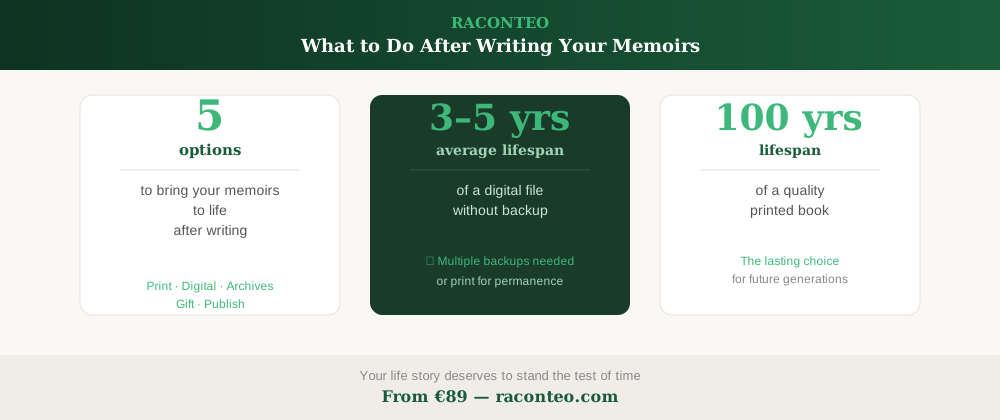
| Digital PDF | Free | Very easy | 3–5 years* | Wide |
| USB stick | €5–15 | Easy | 10–20 years | Family |
| Archives / library | Free | Difficult | Permanent | Researchers |
| Publisher | Variable | Very difficult | Long-term | General public |
*Without regular backups. Digital files without backup disappear far faster than most people realise.
Frequently asked questions
Is it too late to print my memoirs if I wrote them a long time ago? No, it's never too late. As long as you have your text — even handwritten — it can be digitised, laid out and printed. Raconteo can guide you through the process.
Should I have my memoirs proofread before printing? It's strongly recommended. A simple read-through by a loved one is sufficient in most cases. The goal isn't literary perfection but readability and accuracy on important facts.
How much does it cost to print a memoir book? Prices range from €20 (basic self-publishing) to €150 (leather binding, premium printing). With Raconteo, the complete book — layout, cover, printing — starts €89.
Could my memoirs interest a publisher? If your story covers a significant historical period, a disappearing trade or an exceptional life experience, possibly yes. But most memoirs have family value far exceeding their publishing potential. Don't overlook that first circle.
How do I protect my memoirs once shared? Your memoirs are protected by copyright from the moment of creation. You can add a © notice in your book. For stronger protection, consult a solicitor or register with a relevant authors' society.
Ready to bring your memoirs to life?
Raconteo transforms your memories into a quality printed book — from guided interview to delivery. Start free today.