Tribute Book for a Deceased Loved One: How to Gather Your Memories into a Book That Outlasts Time
How to create a tribute book for a loved one who has passed away. A step-by-step guide to gathering a whole family's memories into one book.
Table of Contents
- Why Create a Tribute Book for a Loved One Who Passed Away
- What a Tribute Book Can Hold
- How to Gather Memories From the Whole Family
- The Raconteo Method for a Tribute Book
- Comparison of Memorial Options
- When to Give a Tribute Book
- Approaching the Project With Care
- Testimonials
- Frequently Asked Questions

Anne-Charlotte Triplet — sociologist and co-founder of Raconteo. She has spent three years studying how families pass their memory on, and has guided several hundred memoir books. More about her.
There is a particular fear that visits us in the weeks, months and years after losing someone we loved deeply. It rarely arrives in a single moment. It creeps in quietly. One day you reach for the sound of their laugh and realize you have to work a little harder to hear it. You try to remember the exact way your father pronounced your name, the precise scent of your mother's kitchen on a Sunday afternoon, the small joke your husband told at every family dinner. And you wonder: how do I keep them from fading?
A tribute book for deceased loved one is one of the most tender, lasting answers to that fear. Not a stone, not a plaque, not a video that lives somewhere in a forgotten cloud, but a real, bound book you can hold, open on a quiet evening, and pass into the hands of a grandchild who never met them. A memorial book gathered from everyone who loved them, written in the voices of those who knew them best.
This guide walks you through how to create such a book, gently, without pressure, at your own rhythm. It is written for anyone who has lost a parent, a spouse, a sibling, a grandparent, or a dear friend, and who feels the quiet pull to preserve memory of deceased family member in a form that will outlast all of us.
Why Create a Tribute Book for a Loved One Who Passed Away
A tribute book for deceased loved one is not a project you undertake lightly. It asks something of you: time, attention, a willingness to revisit what hurts. But those who have done it almost always say the same thing afterwards: I am so glad we did. Here is why.
Against forgetting
Human memory is generous but unreliable. The stories we hear at a funeral, the anecdotes shared at the wake, the photographs we promise ourselves we will label one day: they slip. A cousin moves away and takes a chapter of family history with him. A grandparent passes and a thousand small details vanish in a single afternoon.
A remembrance book is a deliberate act of resistance against that erosion. It says: these stories will not be lost, because we wrote them down while we still had them. It is the difference between a memory and a record, and only the record survives the next generation.
A companion through grief
Grief is not a problem to be solved. It is a long companion. But the people who have created a memory book for someone who passed away often describe the process itself as quietly meaningful, a way to spend time with the departed in the safest possible setting. Writing about your father is, for a few hours, being with your father again. Reading what your sister contributed about your mother is hearing your mother through a new voice.
The book does not heal grief (nothing does, fully), but it can accompany the journey. It gives sorrow a place to sit, a shape to take, a purpose to serve.
A bridge across generations
Children born after a grandparent's passing grow up with a gap shaped like that person. A photograph helps, but a photograph cannot tell them how their grandfather met their grandmother, what made him laugh until he cried, what he believed about courage, what he cooked on Sunday mornings.
A book to honor a deceased parent, or grandparent, becomes the bridge. It allows a four-year-old to know her great-grandmother through the eyes of everyone who loved her. It is, very literally, transmission.
A reason for the family to gather
Grief often scatters families. Each person mourns alone, on their own schedule, in their own way. A tribute project does the opposite: it gives the family a shared, gentle task. Calling your brother to ask what he remembers about Dad's old workshop. Writing to your cousin in another city to ask about that one summer in 1987. Sitting with your mother, now widowed, to gather what she most wants the grandchildren to know.
The book becomes a reason to talk. And the talking, often, becomes its own kind of healing.
What a Tribute Book Can Hold
There is no fixed formula for an in memoriam book. The most beautiful tribute books are the ones that look like the person they honor. Below are the kinds of content that families most often weave into their book. Pick what feels right, leave what does not.
Memories and anecdotes
The beating heart of any memorial book is the stories. Not biographical milestones (born in, married in, retired in), but the small, specific scenes that bring a person back to life on the page. The way your father whistled when he came home from work. The Saturday morning your mother spent three hours teaching you to make her tarte tatin. The road trip your brother organized for his fortieth, the one that nearly fell apart and that you all still laugh about.
Specificity is the secret. He was kind fades. He was the kind of man who, when a neighbour's car wouldn't start, would put on his coat at ten at night and go push it down the street with them. That endures.
Photographs
Old photos, badly scanned, with handwritten dates on the back, are gold. A tribute book built around real family photographs (childhood, military service, weddings, holidays, the quiet kitchen shots no one thought were important at the time) becomes both a written and a visual archive. You can include 20 photographs, or 200. There is no wrong number.
Letters, cards, handwriting
If you have a letter your mother wrote you when you left for university, or a postcard your father sent from a trip in 1978, scan it. The handwriting itself becomes part of the tribute, a fingerprint of the person, irreplaceable.
Favourite quotes, sayings, expressions
Every family has them. Your grandfather used to say… Mum always told us… Collect them. A page of family expressions, in the exact words the departed used, will make readers laugh and cry decades from now.
Recipes and rituals
Food is memory. The book to honor a deceased parent that includes her three signature recipes (written down, finally, before they were lost) becomes a working heirloom. Every time a grandchild bakes that cake, the grandmother is present in the kitchen.
The same goes for rituals: how Dad always carved the turkey, the song Mum sang every Christmas Eve, the prayer Grandpa said before dinner.
Values and beliefs
What did this person believe? What did they teach, often without saying it directly? A short chapter on what Dad believed about hard work or what Mum taught us about generosity lifts the book from a chronicle into something closer to a moral inheritance.
Tributes from those who loved them
The most powerful chapters in any remembrance book are often the personal tributes, half a page from each child, the spouse, the siblings, the closest friends. Not eulogies. Just one honest paragraph: what my mother meant to me, in the language only I can use.
How to Gather Memories From the Whole Family
This is where many families freeze. The idea of a tribute book for deceased loved one is beautiful in theory, but how do you actually collect what lives in twelve different heads, spread across three countries, with twelve different relationships to writing?
The honest answer: slowly, kindly, and one person at a time.
Start with the closest circle
Begin with whoever was closest to the departed, usually the spouse, if living, then the children. These are the people whose memories form the backbone of the book. Have a long, unhurried conversation, ideally recorded. Ask open questions: what do you most want the grandchildren to know about him? what's the story you find yourself telling about her most often? what made him laugh? what was she most proud of?
Widen the circle
Then move outward: siblings, in-laws, lifelong friends, colleagues, neighbours. Each will bring a different facet. Your father at work was not your father at home; your mother as a sister was not your mother as a mother.
This is where families often discover stories they never knew. A retired colleague writes two paragraphs about your father's quiet generosity at the office. An old school friend remembers a summer your mother spent as a teenager that no one in the family ever heard about. These windows into who your loved one was before they were yours are some of the most precious pages in any memorial book.
Reach the grandchildren
Do not skip the children. Even a six-year-old's two sentences (Grandpa made the best pancakes and he always had a story) belong in the book. Their voices, preserved on paper, also become a gift to themselves twenty years from now.
Make contributing easy
Not everyone will be comfortable writing. Some people will say I don't know what to say and mean it. Offer alternatives: a voice note they can send you, a phone call you transcribe, a list of simple prompts (one memory of Mum at Christmas, one thing she taught you, one thing you wish you had told her).
The goal is not literary excellence. It is honesty. How to write a tribute to a loved one who passed is not really a question of writing. It is a question of remembering, out loud, in your own words.
The Raconteo Method for a Tribute Book
Raconteo was originally designed to help living parents and grandparents tell their own stories. But families quickly began using it for something we had not fully anticipated: memorial books for loved ones who had passed. Today, a meaningful share of Raconteo books are tribute books, and our method has been shaped, gently, around that reality.
Here is how it works for a tribute project.
Step 1: Open the book in the name of the departed
You create the book as if you were creating it for your loved one. The book carries their name. You become its custodian, the person who gathers, organizes, and shepherds the project.
Step 2: Invite the family to contribute
This is the heart of the Raconteo method: family collaboration. From your space, you invite anyone who knew the departed (children, spouse, siblings, grandchildren, lifelong friends) to contribute memories. Each contributor receives a private, gentle invitation. They write what they remember, at their own rhythm, from wherever they are in the world. No one needs to be a writer. No one needs to be in the same room.
You see the contributions arrive, one by one. You can edit, organize, suggest. Nothing is published until you decide.
Step 3: Guided writing, respectful formatting
Our guided editor proposes themes and gentle prompts adapted to a tribute project: childhood of the departed, their family life, their work, their values, the milestones, the rituals, the small daily things. Each contributor answers what they wish, skips what they don't. The text is then carefully laid out by our editorial team using respectful formatting (typography, spacing, photo placement) so the finished pages feel as dignified as the subject deserves.
There is no rushing. Some families finish their tribute book in three weeks. Others take six months. Both are right.
Step 4: Printing, a real bound book
When the book is ready, it is printed as a hardcover keepsake, the kind of book that sits on a shelf for fifty years, not a glossy souvenir that frays in two. You can order as many copies as the family needs: one for the widow, one for each child, one for each grandchild when they come of age. For €89, you have a real, lasting tribute book for deceased loved one.
Comparison of Memorial Options
There are many ways to honor someone who has passed. Each has its place. Here is an honest look at how a tribute book compares to the alternatives.
| Method | Price | Duration | Effort | Emotion | Legacy |
|---|---|---|---|---|---|
| Memorial card / funeral booklet | $1-3 each | 1 day | Low | Brief, ceremonial | Rarely kept long-term |
| Video tribute (montage) | $0-500 | 1-2 weeks | Medium | Strong on the day | Format obsolescence within 10-15 years |
| Photo album (printed) | $30-80 | Few weeks | Medium | Visual, silent | Lasting, but no stories |
| Self-published memoir (DIY) | $200-600 | 6-18 months | Very high | Variable | Lasting if completed (most are not) |
| Professional biographer | $5,000-20,000 | 6-12 months | Low for family | Polished, sometimes distant | Lasting, single perspective |
| Raconteo tribute book ⭐ | €89 | 3 weeks to 6 months | Low (collaborative) | Deeply personal, multi-voiced | Bound hardcover, made to be passed down |
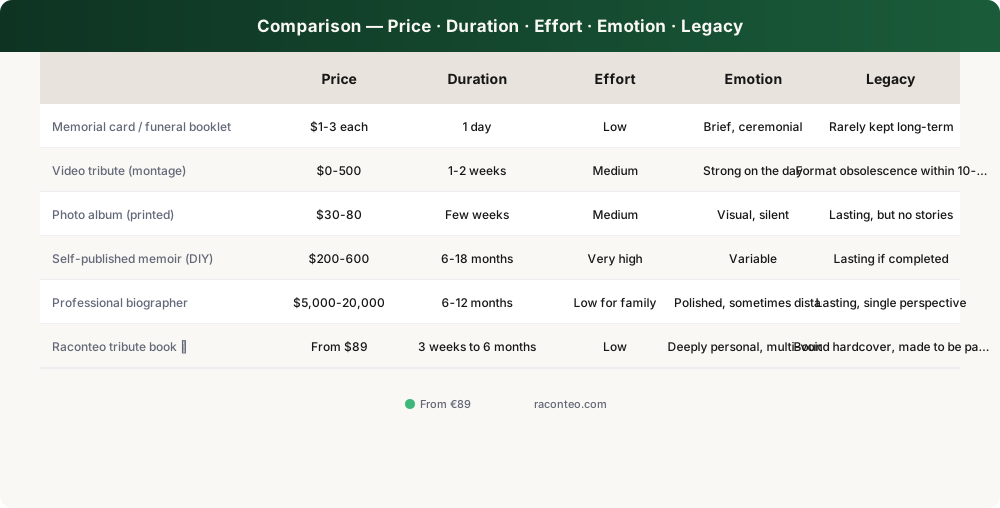
What the table cannot show is the difference in feeling. A memorial card honors the day. A photo album honors the face. A tribute book honors the person: their voice, their stories, the texture of who they actually were. It is the only memorial format that captures all of those things in something a great-grandchild can still hold in their hands in 2080.
When to Give a Tribute Book
There is no wrong moment to create or offer a memorial book. But some moments carry particular weight.
The death anniversary
The first anniversary, the fifth, the tenth: these are days families often dread and then do not know what to do with. Offering the completed tribute book on that day transforms a hard date into a meaningful one. Instead of grief alone, there is grief and gathering, and reading aloud, and discovering pages family members have not seen yet.
The first holidays without them
The first Christmas, the first Mother's Day, the first birthday without the person. These are the hollow days. Having the book to open on those mornings does not fill the absence. But it gives the day a shape. It places the loved one back at the table, in their own words, in the memories of everyone who knew them.
A gift to grandchildren who never knew them
This is perhaps the most moving use of a tribute book. A grandmother passes before her grandchildren are born, or while they are too young to remember. The book becomes their inheritance. When they turn ten, fifteen, twenty, they receive a copy: this is who your grandmother was, written by everyone who loved her, kept for you.
A milestone in the life of the departed
The hundredth birthday they would have celebrated. The fiftieth wedding anniversary that did not happen. A daughter's wedding, where you want the absent father present in some way. The book gives you a way to mark these dates.
Approaching the Project With Care
If you are reading this and the idea is taking root, a quiet word on how to bring it up with your family, because grief is uneven, and what feels healing to one person can feel premature to another.
Wait until it feels right (to you)
There is no correct delay. Some families begin a tribute project within weeks of a death, almost as a way of staying close. Others wait two, five, ten years until the grief has softened enough to revisit memories without being overwhelmed. Both rhythms are valid. Trust your own.
Bring it up gently
When you raise the idea with relatives, do not present it as a fait accompli or a duty. Try something like: I've been thinking about a way for us to gather everything we remember about Mum, before more of it slips away. A book, in her honor, that all of us could contribute to. Would you want to be part of that?
Some will say yes immediately. Some will need time. A few may say no, at least for now. That is also fine.
Respect every rhythm
Not everyone grieves the same way. A sister who cannot bring herself to write three paragraphs about your mother right now is not failing. She is grieving. Leave the door open. People often join a tribute project months after declining the first invitation, when something has shifted inside them.
Listen more than you ask
When relatives do start sharing memories, your job is to receive them, not to correct them. Two siblings will remember the same Christmas differently. Both versions belong in the book. The point is not historical accuracy: it is emotional truth, in as many voices as the family contains.
Testimonials
"I made a Raconteo book for my father, two years after he died. I invited my mother, my brother, my aunt, and three of his oldest friends. What arrived on those pages was a father I thought I knew completely, and didn't. My aunt wrote about him as a boy. His best friend wrote about a side of him I had never seen. The day the book arrived, I read it from beginning to end on the kitchen floor. I have given a copy to each of my children. He is still with us, in a way I did not think possible." Sarah, 47, in memory of her father
"We were five siblings, scattered across three countries. After Mum passed, we could feel the family loosening: fewer reasons to call, fewer occasions to come back home. One of us suggested a book. It took us seven months. We argued, we cried, we laughed at things none of us had told the others. The book itself is beautiful. But what it gave us along the way, that is the real gift. Mum is gone, but she pulled us back together, one last time." Marie, 53, with her four siblings, in memory of their mother
"I lost my husband when our children were nine and twelve. I waited five years before I could face the idea of a book. When I finally did, I invited his brother, his oldest friend, his colleagues, and the children themselves. Reading what our son wrote about his father, two short paragraphs at fourteen years old, I understood that he was going to be all right. The book is on the living room shelf. The children open it when they need to. So do I." Hélène, 49, in memory of her husband
Frequently Asked Questions
How long does it take to create a tribute book?
Most families finish their book between three weeks and six months. Three weeks is possible if a single person writes most of it, drawing on their own memories and a small handful of photos. Six months is more typical when many relatives contribute. There is no clock: the book is ready when you say it is ready.
What if I don't feel able to write much myself?
You do not have to write a single full paragraph if you do not want to. Our guided editor proposes gentle prompts, and you can answer with a few sentences, a voice note transcribed by our editorial team, or simply by inviting others to contribute. Many tribute books are largely written by the wider family, with the project lead acting as the curator rather than the author.
Can we include old photos, even if they are damaged?
Yes. Scan them (even imperfectly, even from a phone camera) and we will handle the layout with respectful formatting. A faded 1950s wedding photo, slightly creased, often becomes the most moving image in the book precisely because it is imperfect. If a photo is too damaged, our editorial team can advise on what to do.
Who can contribute to the tribute book?
Anyone you invite: the spouse, children, siblings, grandchildren, nieces and nephews, in-laws, lifelong friends, colleagues, neighbours. Each contributor has their own private access and writes at their own rhythm. You decide who is invited, who can see what, and what ultimately appears in the final book.
Do we need many people to make a good tribute book?
No. Some of the most beautiful memorial books are written by a single person: a widow for her husband, a daughter for her mother. Others involve twenty contributors. Both work. What matters is honesty, not headcount. A short tribute book full of specific, true memories is worth more than a long one padded with generalities.
What if some relatives don't want to participate?
That is normal, and it is fine. Grief is private, and not everyone is ready at the same moment. Invite them gently, accept their answer, and leave the door open. Many relatives who decline at first ask to contribute later, once the project has begun and they see what is taking shape. The book does not need to be unanimous to be true.
A tribute book for deceased loved one will not bring them back. Nothing will. But it can do something almost as important: it can make sure that, fifty years from now, a child you have not yet met will be able to open a book, read your father's stories in your aunt's voice and your mother's photographs in your brother's words, and know him. Not as a name on a stone. As a person.
That is worth a few months of careful, loving work. It is, in the deepest sense, what families are for.
If you would like to begin, at your own rhythm, with whoever feels ready, we are here.
Create a tribute book with Raconteo for €89
To go further on memory, legacy and family transmission:
- Honoring the memory of loved ones on All Saints' Day
- How to leave a meaningful family legacy
- Preserving the memories of our elders before it is too late
- Memoirs and genealogy: telling the story of our ancestors
- How to organize family memories into a lasting archive
- Telling your life story to your children