Tell Your Life Story to Your Children: Why and How to Pass On Your Life Legacy (2026)
How to share your life story with your children and grandchildren? A complete guide to passing on your experiences, values and memories through an authentic life narrative.
Tell Your Life Story to Your Children: Why and How to Pass On Your Life Legacy
Do your children really know who you are? Not the parent, not the grandparent — but the person you were before them, the one who faced challenges, loved, chose, built a life. Most adults answer no to that question. And most regret not asking more questions while there was still time.
Sharing your life story with your children isn't about ego. It's a concrete act of love, a bridge between generations, and one of the most lasting gifts you can give.
Table of Contents
- Why your story matters to your children
- What your children don't know about you yet
- When to start?
- 4 formats for sharing your story
- How to make your story captivating
- Involving your children and grandchildren
- Comparison table of formats
- Create a life book with Raconteo
- Frequently asked questions
Why your story matters to your children
Psychologists at Emory University found that children who know their family history have better self-esteem, greater resilience in the face of difficulties, and a stronger sense of identity. This is significant: knowing where you come from helps you know who you are.
Your children — even as adults — need your story. They need to understand why you made certain choices, what values guided you, what battles you fought. These narratives become a compass for them, an identity foundation, an invisible but essential legacy.
And if they're not asking yet, it's often because they don't know what they don't know.
What your children don't know about you yet
Try this: ask your children to tell you about your childhood. They probably know a few anecdotes, a few dates — but the details, the emotions, the choices that shaped you? Rarely.
They probably don't know:
- What your dream was at 20, and how life changed its course
- What moment made you most proud or most ashamed
- How you got through difficult times — grief, crises, doubts
- What fundamental value has guided all your decisions
- What you would have done differently if you could start over
These gaps are not their fault. No one asked you the right questions at the right time. That's why you need to take the initiative — and not wait for them to take it.
To learn more about the value of these stories, read our article on the benefits of writing your memoirs.
When to start?
Spoiler: now. Not "someday", not "when I have more time", not "when the kids are available".
Three reasons to start today:
1. Memory becomes fragile with time. Precise memories, names, dates, sensory details — all of this fades. What you can recall precisely today will be hazier in five years.
2. The unexpected happens. An illness, an accident, a stroke — nobody anticipates these events. Every day without leaving a trace is an unnecessary risk.
3. Your children need you now, not your memory. A book created together, a recorded conversation, a shared project — these are all moments of real connection, in addition to the legacy.
4 formats for sharing your story
1. Conversation around the table
The most natural, the most immediate. A family evening, some prepared questions, a shared meal. The advantage: spontaneity, laughter, warmth. The major drawback: nothing remains. In ten years, who will remember exactly what grandfather told that evening?
2. Audio or video recording
A smartphone is enough. You speak, someone records. The result is vivid, authentic — your voice, your intonations, your silences. More lasting than pure oral, but requires careful storage and risks staying on a hard drive nobody opens.
3. Journal or life notebook
Writing by hand or typing your memories, chapter by chapter. Accessible to everyone, without technology. But the exercise can discourage if you lack structure, questions to guide you, or someone to review your work.
4. Printed book
The most complete and lasting format. A real book, with your story laid out, bound, printed. You can offer it in several copies — one for each child, one for grandchildren, one for the family library. This is the object that will survive decades.
Discover how to tell your life story without being a writer — solutions exist for every profile.
How to make your story captivating for future generations
A common mistake: telling a chronology. "I was born in 1948, I studied in Lyon, I met your mother in 1972..." This type of narrative, however factual, puts people to sleep.
What captivates is emotion and inner conflict. Ask yourself:
- What moment truly changed you? Not an event — an inner transformation.
- What decision cost you something? Every choice has a price. Naming it makes it human.
- What made you laugh until you cried? Joyful memories are equally precious.
- What obstacle seemed insurmountable, and how did you overcome it?
The secret of a captivating life story: alternating difficult moments with luminous ones. Neither perpetual complaint nor idealized life — but a nuanced truth.
Involving your children and grandchildren in the project
Transmission shouldn't be a monologue. Here's how to make it a family project:
Ask them what questions they always wanted to ask you. You'll often be surprised by the depth of their curiosity.
Propose an informal interview. A child or grandchild who interviews you — with a real microphone or just a phone — creates a different dynamic, more relaxed, richer.
Share drafts. If you're writing, send excerpts to your loved ones. Their feedback will motivate you to continue.
Make it a gift. Announcing that you're preparing a book for a parent's 70th birthday, or for Christmas — that gives a framework, a deadline, and anticipated emotion.
To explore projects around passing on values, also read our guide on passing on your values to your grandchildren.
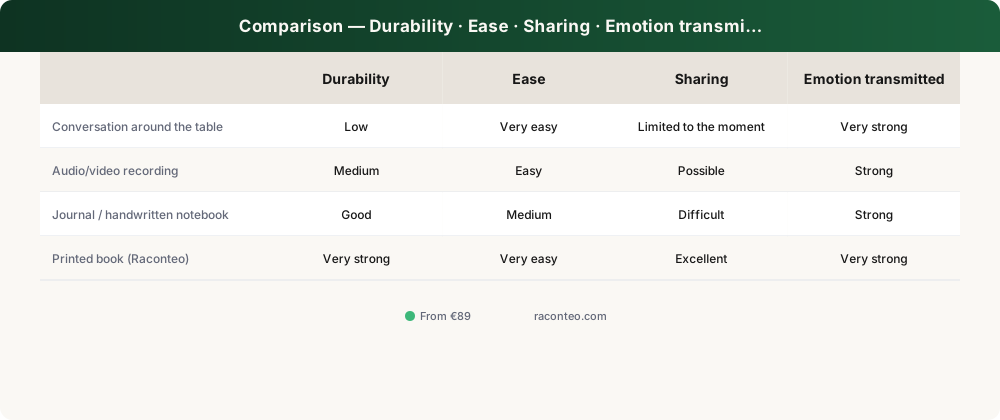
Comparison table: transmission formats
| Format | Durability | Ease | Sharing | Emotion transmitted |
|---|---|---|---|---|
| Conversation around the table | Low (ephemeral) | Very easy | Limited to the moment | Very strong |
| Audio/video recording | Medium (if stored well) | Easy | Possible (file) | Strong (real voice) |
| Journal / handwritten notebook | Good | Medium | Difficult (1 copy) | Strong (personal writing) |
| Printed book (Raconteo) | Very strong (decades) | Very easy (guided) | Excellent (multiple copies) | Very strong |
Create a life book with Raconteo — the ideal format for transmission
Raconteo is a platform designed for people who want to share their story without having to write or master technology. The principle is simple:
- You answer guided questions — by theme, at your own pace, orally or in writing
- AI transforms your answers into a fluid narrative — in your style, with your words
- You receive a printed book — professionally laid out, bound, ready to give
No literary talent required. No need to know how to structure a narrative. The questions do the guiding work, and the AI assembles the pieces.
The result: a book your children can keep, reread, and pass on to their own children. An object that lasts.
From €89, delivery in 21 days.
To learn more about what a Raconteo book contains, read our article on personalised biographical books.
Frequently asked questions
My children aren't interested in my story. Is that normal?
Yes, it's very common. Family curiosity often awakens late — sometimes after a death, an illness, or simply with age. Don't wait for them: start for them, even if they're not asking yet. When the book exists, it will speak for you.
I haven't had an extraordinary life. Is my story worth telling?
Always. What your children are interested in isn't fame or achievement — it's you, your daily life, your thoughts, your ordinary choices. An ordinary life told honestly is infinitely more precious than an invented heroic biography.
What is the minimum age to start?
There is none. People from age 55 to 85 use Raconteo. The earlier you start, the clearer the memories — but it's never too late.
How do you approach painful or sensitive topics?
You choose what you share. No obligation to say everything. A life story isn't a confession — it's an intentional selection of what you want to transmit. You keep control.
How long does creating a Raconteo book take?
Most users finalize their book in 4 to 8 weeks, answering a few questions per week. The pace is entirely free.
Your story deserves to last
Every day that passes without leaving a trace is a blank page in your family's album. Your children and grandchildren will need to know you — truly know you — long after you're no longer there to answer their questions.
Start today. Not for yourself — for them.