Write Your Childhood Memories: Complete Guide to Capturing Your Most Precious Souvenirs (2026)
How to write your childhood memories? Methods, key questions and practical tips to put your most precious memories on paper before they fade away forever.
Table of Contents
- Why Childhood Memories Are the Most Precious
- Triggers That Bring Back Memories
- 7 Essential Childhood Themes to Write About
- How to Write When Memories Are Hazy
- Involving Your Family to Enrich the Stories
- Comparison Table: Formats for Preserving Childhood Memories
- Frequently Asked Questions
- Start Writing Your Childhood Memories Today

Anne-Charlotte Triplet — sociologist and co-founder of Raconteo. She has spent three years studying how families pass their memory on, and has guided several hundred memoir books. More about her.
Close your eyes. Think about the kitchen of your childhood: the smell of toast in the morning, the oilcloth tablecloth, your mother's voice. Those images are there, somewhere, nestled deep in your memory. They are precious. They are irreplaceable. And if no one commits them to paper, they will disappear with you.
Writing your childhood memories is far more than a nostalgic exercise. It's an act of transmission: offering your children, grandchildren and future generations a window onto a world they never knew. It's also, for you, an inner journey of unexpected richness.
This guide walks you through the process, from the first triggers to the finished story.
Why Childhood Memories Are the Most Precious
The Memory of Childhood: An Indelible Imprint
Neuroscience researchers have uncovered a fascinating phenomenon: 60% of our most vivid memories come from childhood and adolescence. This period, which psychologists call the "reminiscence bump", is when our developing brain records experiences with particular intensity. First times (the first day of school, the first bicycle, the first love) leave deep traces that decades cannot erase.
This is why childhood memories form the heart of any memoir project. They reveal who you were before life shaped you, which values you inherited, what world you grew up in.
An Irreplaceable Family Heritage
80% of adults say they regret not having asked their grandparents more questions before they passed away. Their childhood memories (school during wartime, summers on the farm, life without electricity) left with them. You now have the opportunity to do things differently.
Writing your memories stimulates cognition, strengthens self-esteem and creates a living bridge between generations. If passing on your values matters to you, beginning with your childhood memories is the most natural path.
Triggers That Bring Back Memories
Memories don't always surface on demand. But certain triggers are remarkably effective at bringing them back.
Old Photos and Family Albums
A faded black-and-white photograph can unlock dozens of forgotten details. Who were those neighbours? What was that fabric? What happened that day? Take time to leaf through your albums before you write.
Smells and Tastes
Marcel Proust immortalised it with his madeleine: smell is the sense most directly connected to emotional memory. The scent of cut hay, Marseille soap, a warm apple tart. These sensations instantly bring entire scenes from your past flooding back.
Music and Songs
Listening again to the hits of your childhood is one of the most powerful triggers. Every song is associated with a specific context, with faces, with emotions.
Places from Childhood
If you can, return to the key places of your childhood. Or, if that's impossible, find photos of those places online. The family home, the school, the church, the main street of the village: these places speak directly to your memory.
Objects
A toy found in an attic, a yellowed letter, a school report: objects are living archives. Hold them in your hands and let the memories rise.
7 Essential Childhood Themes to Write About
Not sure where to start? These seven themes cover the essentials of what deserves to be told.
1. The Family Home
Describe your childhood house or flat using all your senses. The sound of the floorboards, the colour of the shutters, the layout of the rooms, the garden. Who lived there? What rules governed the household?
2. School and Learning
Your memorable teachers, your best friend from the playground, the subjects you loved or hated. School is often the first social arena, and memories there are rich.
3. Games and Pastimes
What did you do for fun? Outdoor games, favourite toys, board games with the family. These details tell an era's story better than any history book.
4. Meals and the Family Table
Food is a powerful cultural and family marker. Sunday meals, holiday dinners, table rituals. Who cooked? What were the customs?
5. Holidays and Trips
First travels, summers at the grandparents', holiday camps. These moments outside daily routine are often among the most vivid memories.
6. First Times
First day of school, first communion, first love, first disappointment. "First times" are natural narrative milestones, and each deserves its own story.
7. Significant People
Grandfather with his wartime stories, the neighbour who looked after you, the teacher who changed your life. The people who mattered deserve their own portrait. It's also an opportunity to explore autobiography question ideas and make connections between generations.
How to Write When Memories Are Hazy
It's perfectly normal for some memories to be imprecise, fragmentary or uncertain. Memory is not a camera: it reconstructs, reinterprets, forgets details and invents others.
Some tips for writing despite uncertainty:
- Acknowledge the imprecision: write "I believe I remember", "it seems to me", "something like". Your honesty makes the story more human.
- Separate the memory from the feeling: even if you're no longer sure of the exact date or place, you can describe precisely how you felt at that moment.
- Leave blanks: it's better to leave an open question than to invent details. You can always come back and fill them in later.
- Cross-reference with other sources: photos, letters, documents, or simply a sibling's memory.
Involving Your Family to Enrich the Stories
Your memories are precious, but they're also subjective and partial. Involving your family considerably enriches the narrative.
Ask Your Brothers and Sisters
They lived through the same events but experienced them differently depending on their age and temperament. Comparing your memories is often a source of revelations, and laughter.
Ask Your Children What They Want to Know
Your children and grandchildren almost certainly have questions they've never dared ask. Invite them to put them into words. Their questions will guide you towards the stories that really matter. You can find tips in our guide to interviewing your grandparents.
Reconnect with Old Friends or Neighbours
Social networks sometimes allow you to reconnect with former classmates or neighbours you've lost touch with. A simple exchange can bring back memories buried for decades.
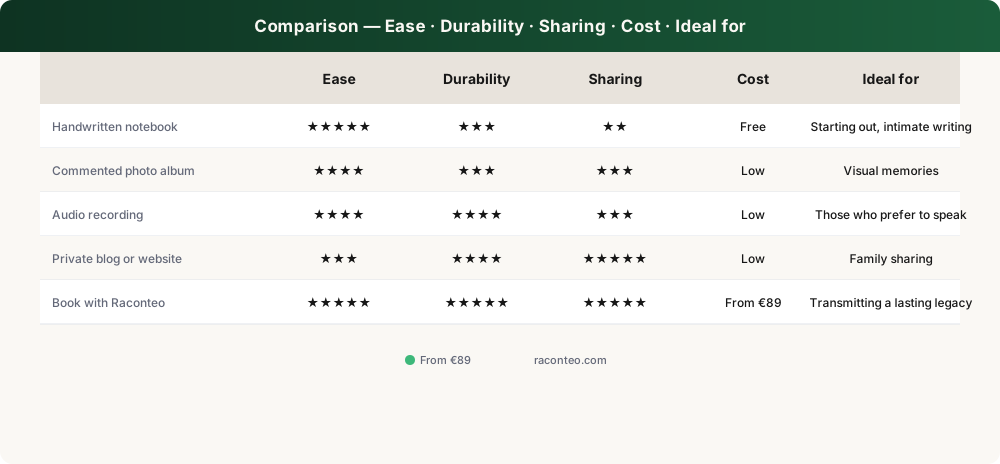
Comparison Table: Formats for Preserving Childhood Memories
| Format | Ease | Durability | Sharing | Cost | Ideal for |
|---|---|---|---|---|---|
| Handwritten notebook | ★★★★★ | ★★★ | ★★ | Free | Starting out, intimate writing |
| Commented photo album | ★★★★ | ★★★ | ★★★ | Low | Visual memories |
| Audio recording | ★★★★ | ★★★★ | ★★★ | Low | Those who prefer to speak |
| Private blog or website | ★★★ | ★★★★ | ★★★★★ | Low | Family sharing |
| Book with Raconteo | ★★★★★ | ★★★★★ | ★★★★★ | €89 | Transmitting a lasting legacy |
A personalised biographical book remains the most durable and moving format, a physical object your loved ones can hold in their hands for generations.
Frequently Asked Questions
What is the ideal age to start writing childhood memories?
There is no ideal age, but the sooner, the better. Memory gradually fades after 60, and the people who could have confirmed your stories disappear. If you're thinking about it today, today is the right time. Even 15 minutes a week is enough to build, within a few months, a complete account.
How can I recover childhood memories I've forgotten?
Use sensory triggers: period photographs, music from your childhood, familiar smells, returning to places. Talk with brothers and sisters or former friends. Consult family archives, letters, documents, old local newspapers. Often, one detail brings back ten others.
Should I include difficult or painful memories?
You are the sole judge of what you wish to share. Some people find it liberating to put difficult episodes into words; others prefer to leave them aside. A simple rule: write what you want your loved ones to remember. Painful memories, when shared with perspective and context, can bring a human dimension and a valuable lesson.
How do I organise my childhood memories chronologically?
You're not obliged to follow chronological order. In fact, few good memoirs do. You can organise your memories by themes (home, school, holidays), by characters (grandmother, best friend) or by emotions (moments of joy, great fears, prides). The important thing is that your reader can follow along easily.
Is it possible to write childhood memories if you don't enjoy writing?
Absolutely. You can dictate your memories aloud, to a loved one, to a recorder, or directly to a tool like Raconteo which transforms your answers into structured stories. Many people who say they're "bad at writing" turn out to be excellent oral storytellers. Writing talent is not required: only your story counts.
Start Writing Your Childhood Memories Today
Your childhood memories are unique. They carry the imprint of an era, a background, a family: a testimony that no one else can offer in your place. Every week that passes, details fade and witnesses disappear.
With Raconteo, you answer guided questions at your own pace, and our AI transforms your answers into a fluid and moving story. In less than a year, writing one story a week, you have a complete book in your hands, a legacy your loved ones will cherish forever.