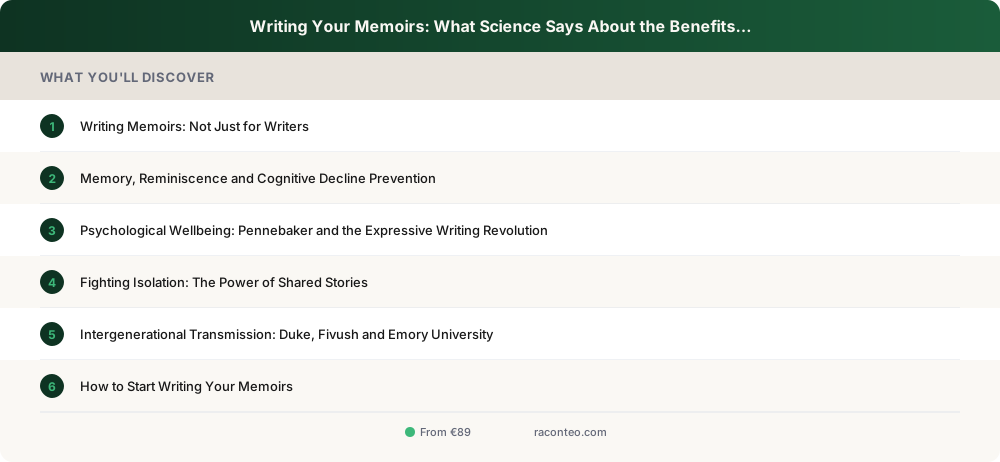
Writing Your Memoirs: What Science Says About the Benefits for Health, Memory and Future Generations
Science backs the benefits of writing your memoirs: better memory, fewer doctor visits (−50%, Pennebaker), and a legacy passed down the generations.
Table of Contents
- Writing memoirs: not just for writers
- Memory, reminiscence and cognitive decline prevention
- Psychological wellbeing: Pennebaker and the expressive writing revolution
- Fighting isolation: the power of shared stories
- Intergenerational transmission: Duke, Fivush and Emory University
- How to start writing your memoirs
- Frequently asked questions

Anne-Charlotte Triplet — sociologist and co-founder of Raconteo. She has spent three years studying how families pass their memory on, and has guided several hundred memoir books. More about her.
Writing Memoirs: Not Just for Writers
We often imagine that telling one's life story is reserved for celebrities, politicians or professional authors. Yet for the past thirty years, researchers in psychology, neuroscience and gerontology have been documenting something remarkable: telling one's life story produces measurable and profound effects on health, memory, psychological wellbeing and family bonds.
This isn't intuition. It's science.
Hundreds of studies, meta-analyses and randomised controlled trials conducted at the world's leading universities (Emory, Texas, Cambridge) converge on the same conclusion: writing or telling one's memories transforms the storyteller, and protects those who listen.
This article gathers the most robust scientific evidence across four areas: memory, psychological wellbeing, the fight against isolation, and intergenerational transmission.
Memory, Reminiscence and Cognitive Decline Prevention
Reminiscence therapy: a validated intervention
Reminiscence therapy, inviting an older person to explore and tell their autobiographical memories, is today one of the best-documented non-pharmacological interventions in geriatrics.
An umbrella review published in 2025 in BMC Geriatrics compiled 21 systematic reviews and meta-analyses covering 246 randomised controlled trials and more than 18,000 participants. Result: reminiscence therapy significantly improves global cognition in older adults with dementia (effect size g = 0.18), and reduces depressive symptoms (g = −0.49).
A study published in the Journal of Clinical Medicine (2022) on Alzheimer's patients specifically concludes that reminiscence therapy should be integrated into routine care for institutionalised residents. It is no longer an option. It is a clinical recommendation.
Why autobiographical memories resist
The mechanism is neurological. In people with dementia, long-term autobiographical memories are often better preserved than recent memory. Photographs, music and childhood narratives reactivate deeply embedded neural networks, where new information no longer manages to take hold.
Telling one's story means exercising and preserving precisely the most resilient brain regions: training memory where it is still strong, to delay decline where it is more fragile.
Life story books: a recognised therapeutic tool
A systematic review published in ScienceDirect in 2024 shows that life story books (books built with older adults from their memories) improve their quality of life and facilitate communication between patients and their carers. They allow care staff to see the person beyond their illness, and the person to feel recognised in the full richness of their journey.
Key fact: More than 18,000 participants, 246 clinical trials. Reminiscence therapy is not a leisure activity. It is a medical intervention.
Psychological Wellbeing: Pennebaker and the Expressive Writing Revolution
The founding experiment
In 1986, psychologist James Pennebaker at the University of Texas ran an experiment that would change clinical psychology. He divided 46 students into groups: some wrote 15 minutes a day for 4 consecutive days about neutral facts; others wrote about their most difficult emotional experiences (their history, traumas, fears).
The result was astonishing: in the following six months, students who had written about their deep emotional experiences visited a doctor twice as rarely (−50%) as the control group. Their immune markers had measurably improved.
This study gave birth to an entire field of research. Since 1986, more than 400 studies have tested and confirmed this protocol across diverse populations: from cancer survivors to the unemployed to the bereaved.
Life review therapy against depression in seniors
"Life review therapy" is a structured form of guided reminiscence specifically designed for older adults. A meta-analysis by Bohlmeijer et al. shows a remarkable effect size of d = 0.84 on reducing depressive symptoms, a level of efficacy comparable to some forms of structured psychotherapy.
Researcher Gerben Westerhof summarises the mechanism: when an older person reviews their life journey integratively (finding meaning in hardships as much as in joys), they develop a sense of identity coherence that protects against depression, anxiety and emptiness.
Building meaning, not just telling stories
What distinguishes life review from ordinary reminiscence is the act of giving meaning. Why these choices? What did I learn from this hardship? What thread runs through my life? These questions are not just beautiful. They are therapeutic.
Difficulties in constructing a coherent autobiographical narrative are directly correlated with lower levels of mental health. Conversely, people who manage to tell their lives integratively, accepting contradictions and pain, show significantly higher wellbeing scores.
Key fact: −50% medical visits (Pennebaker, 1986). Effect size d = 0.84 on depression (Bohlmeijer). Over 400 studies confirm the benefits of writing on psychological wellbeing.
Fighting Isolation: The Power of Shared Stories
Isolation: a public health emergency
The World Health Organisation has recognised social isolation in older adults as a global public health priority. The data is stark: chronic social isolation increases the risk of dementia by approximately 50%. It is associated with increased cardiovascular risk, more frequent depression, and premature death.
This is not a question of character or temperament. Isolation is an environmental condition, and it is combated through meaningful connections.
Intergenerational programmes: 77% of studies show benefits
A systematic review by Whear et al. (2023) in Campbell Systematic Reviews analysed 26 studies on formal intergenerational programmes. Result: 77% of studies (20 out of 26) report positive outcomes for both generations involved: improved relationships, general wellbeing, and reduced age-related stereotypes.
Sharing life stories between elders and young people doesn't only benefit the elders. It changes how young people perceive ageing. It builds bridges where contemporary society has erected walls.
Telling your story means existing in others' eyes
When an older person tells their memories to their children, grandchildren or carers, something fundamental happens: they stop being perceived merely as "an elderly person" and become a person with a history, an identity, a depth. They become a subject again.
This change in perspective (being seen in the full complexity of one's journey) is one of the most powerful antidotes to emotional isolation. You don't need to be surrounded by crowds to feel lonely. It is enough to feel invisible.
Key fact: Isolation increases dementia risk by 50%. 77% of intergenerational story-sharing programmes improve wellbeing for both generations.
Intergenerational Transmission: Duke, Fivush and Emory University
The "Do You Know?" scale: the discovery that surprised researchers
In the early 2000s, psychologists Marshall Duke and Robyn Fivush at Emory University in Atlanta were looking to identify indicators of emotional wellbeing in children. They developed the "Do You Know?" (DYK) scale, 20 questions asked of children about their family history: "Do you know where your parents met?", "Do you know if anyone in your family went through a serious illness?", "Do you know where your family name comes from?"
The discovery surprised even the researchers: knowledge of family history turned out to be the single best predictor of children's emotional wellbeing and resilience among all indicators tested.
Children who knew more of their family's history showed:
- A higher sense of control over their lives
- Stronger self-esteem
- Less anxiety and fewer behavioural problems
- Better social competence
September 11 and resilience through stories
The Duke and Fivush study began in the summer of 2001. Two months later, September 11 occurred. The researchers re-interviewed the children. Those who knew the most about their family's history demonstrated significantly greater psychological resilience in the face of the national trauma, without having been directly affected.
Marshall Duke explains: "There are heroes in these stories, people who faced the worst and came through. This sense of continuity and belonging to heroes seems to give children greater resilience."
Adolescence and narrative identity
Later work by Robyn Fivush (2021) shows that adolescents who know more family stories, and who construct coherent and elaborate intergenerational narratives, show:
- Richer identity exploration
- A stronger sense of purpose and direction in life
- Less depression and anxiety
Family stories are not nostalgic. They are foundational. They answer the existential question of adolescence: "Who am I?" by offering a rooted answer: "You come from here. This is where your strength comes from."
What grandparents transmit without knowing it
According to Fivush's research, family stories are transmitted primarily during family dinners, holidays and celebrations. And the principal "memory guardians" are mothers and grandmothers.
What this research implies: every time a grandmother tells her grandchildren how she met their grandfather, or how their father was mischievous at school, she builds something invisible but powerful, a sense of belonging that will accompany them throughout their lives.
And that something disappears with her if it is not preserved. To understand how writing memoirs helps build a lasting family legacy, read our article on how to leave a family legacy.
Key fact: Knowledge of family stories is the single best predictor of children's emotional wellbeing (Duke & Fivush, Emory University). Its effects are visible even in the face of collective traumas.
How to Start Writing Your Memoirs
The blank page: the first obstacle
Knowing that telling your life is beneficial is not enough. The greatest obstacle for most people is not lack of memories: it is not knowing where to begin.
"I have nothing extraordinary to tell." That's the most common response. And the most wrong. Every life is extraordinary, as long as you ask the right questions.
Questions that surface memories
Research on reminiscence therapy shows that sensory and concrete memories are the best triggers. Not "Tell me about your childhood" (too vague, too daunting), but:
- "What could you see from your childhood bedroom window?"
- "What was the smell of your parents' house?"
- "Who was your favourite teacher at school, and why?"
- "What was Sunday morning like at home when you were 10?"
These are the questions that open doors. They are concrete, anchored in the sensory, and they don't require abstract thinking or synthesis. If you want to make this a regular practice, our guide on keeping a personal diary as a senior offers practical advice on building the habit.
Raconteo: an approach grounded in science
This is precisely the principle on which Raconteo was built. The platform guides older adults through carefully designed thematic questions, at their own pace, allowing them to respond in writing or by voice. Artificial intelligence transforms their answers into fluid narrative texts that respect their voice and preserve their turns of phrase.
At the end: a book. Their words, their story, their life, preserved for their children and grandchildren.
If you'd like to give this gift to a parent or grandparent, discover our memoir gift page. Or create your free account to start your own story.
The science is clear. Telling your story is taking care of yourself, and of those you love.
Frequently Asked Questions
Is it proven that telling your life story helps memory?
Yes. An umbrella review published in 2025 in BMC Geriatrics compiled 246 randomised controlled trials involving over 18,000 participants. Reminiscence therapy significantly improves overall cognition and reduces depressive symptoms in older adults, including those with dementia.
Does writing memoirs help against depression?
The studies are very clear on this point. Life review therapy shows an effect size of d = 0.84 on reducing depression in seniors (Bohlmeijer et al.), a level of efficacy comparable to structured forms of psychotherapy. Psychologist James Pennebaker also demonstrated that writing about emotional experiences reduced medical visits by 50%.
What benefits do children gain from knowing their grandparents' stories?
The research by Marshall Duke and Robyn Fivush (Emory University) is remarkable: knowledge of family history is the single best predictor of children's emotional wellbeing. Children who know their family's stories have better self-esteem, less anxiety, and show greater resilience in the face of trauma. These effects were observed after September 11, 2001.
Do you need to write well to write memoirs?
No. The scientific benefits of reminiscence and life review are independent of writing style. What matters is the act of telling: putting memories, emotions and one's journey into words. Tools like Raconteo allow you to speak your story out loud, then transform these accounts into fluid narrative texts. Writing becomes accessible to everyone.
What age should you start writing memoirs?
There's no ideal age, but there is a deadline. Many find that retirement is the natural moment to begin: discover why in our article on memoir writing as a fulfilling retirement activity. Autobiographical memories gradually fade over time. The recommendation from specialist therapists is not to wait, and to start as soon as you feel the desire or the intuition. Benefits are documented at all adult ages, but are particularly well-evidenced after age 60.