How to Write Your Memoirs When You Have a Bad Memory: 8 Techniques (2026)
Think you can't remember anything? You have more memories than you realize. Discover 8 techniques to write your memoirs despite a failing memory.
Table of Contents
- "I can't remember anything": the #1 barrier
- Why memory fades over time
- You have more memories than you think
- 8 memory triggers
- When memories are uncertain
- Writing with early-stage Alzheimer's
- Trigger comparison table
- Frequently asked questions

Anne-Charlotte Triplet — sociologist and co-founder of Raconteo. She has spent three years studying how families pass their memory on, and has guided several hundred memoir books. More about her.
"I can't remember anything. My life is too ordinary. I have nothing interesting to tell." These are the three phrases we hear most often when talking about writing memoirs. And all three are wrong.
The reality is gentler and more surprising: memory doesn't disappear. It hides. And with the right triggers, it resurfaces with a precision that astonishes even those who were convinced they had forgotten everything.
This guide gives you 8 practical techniques to unlock your memories, even if you think you have a bad memory.
"I can't remember anything": the #1 barrier
The belief that you have a bad memory is the most common barrier to writing memoirs. Before even starting, you tell yourself: "What's the point of trying if I can't remember anything?"
But this belief is itself a defense mechanism. Writing your memoirs means confronting your life as it was. It's sometimes painful, sometimes unsettling. The brain, in its kindness, puts up barriers.
What we call "bad memory" is often:
- Selective memory: you've forgotten the everyday, but not the emotionally charged moments
- Intimidated memory: the memory is there, but you judge it too mundane or too intimate to share
- Memory on standby: it's just waiting for a trigger to rise to the surface
The proof? Ask someone who "can't remember anything" to describe the smell of their grandmother's kitchen. They'll rarely be at a loss for words.
Why memory fades over time
Memory aging is a normal process, not a disease. With age, the brain prioritizes: it keeps what mattered, it erases the superfluous. It's a form of intelligence.
What happens in practice:
- Episodic memory (specific events) fades more easily
- Semantic memory (knowledge, skills) remains intact for a long time
- Emotional memory (feelings associated with moments) is the most resilient
A forgotten memory isn't erased. It's simply less accessible. And neuroscience has shown that sometimes all it takes is a sound, a smell, or an image to bring it back with striking precision.
You have more memories than you think
Memory comes in several forms:
Implicit memory: what your body knows how to do without you thinking about it. You remember how butter was made on the farm, how you folded sheets with your mother, how you played hopscotch. These are memories.
Procedural memory: learned gestures. You still know how to handle the tools of your first trade. These gestures tell the story of an era.
Emotional memory: impressions. You may not remember the words of an argument, but you remember the cold in the room, the evening light, the feeling in your chest. These sensations are memories.
Collective memory: you may remember shared events better (the end of World War II, the Moon landing, the fall of the Berlin Wall) than personal ones. These collective moments serve as anchors to retrieve your personal memories from the same period.
8 memory triggers
1. Photos and albums
Browsing old photo albums is one of the most effective techniques. A photo doesn't just trigger the memory of the photographed event: it opens the door to everything surrounding it. Who was there? Where were you? What was the atmosphere? What happened that day before and after?
Tip: don't look at photos in silence. Comment on them out loud, ideally with a loved one who can ask you questions.
2. The music of your era
Music is the most powerful memory trigger according to neuroscience studies. It simultaneously activates multiple brain regions, including those linked to emotions and autobiographical memory.
Create a playlist of memorable songs from each decade of your life. Listen to them in chronological order. Let whatever comes, come: images, names, places, smells. Write everything down immediately.
3. Smells and flavors
Olfactory memory is the most ancient in the human brain. A smell can cross decades in a second. The smell of fresh bread, a particular soap, a flower from the garden. Each one can open a direct corridor to the past.
The same goes for flavors. Cooking or tasting a dish from your childhood can bring back memories buried for fifty years.
4. Places from your past
Revisiting a place filled with memories (your hometown, a former school, your childhood home) reactivates memories that weren't accessible otherwise. If physical travel is impossible, Google Street View photos or old postcards can produce a similar effect.
5. Objects filled with history
An old toy, an inherited watch, a school notebook, a letter kept in a box. Holding an object in your hands activates a different kind of memory than reading or contemplating. The tactile dimension awakens associations that other triggers can't reach.
6. Family conversations
A brother, a sister, a cousin remembers things you've forgotten. And vice versa. Conversations between witnesses of the same era circulate memories: one says something, another adds to it, a third corrects, and everyone ends up remembering details that none would have found alone.
These conversations can be recorded so nothing is lost.
7. Newspapers, archives, and letters
Family archives (family records, school reports, administrative documents), local newspapers from the years of your youth, letters received or kept: all these documents serve as chronological anchors. When you see a date, a name, a place, memories fall into order.
Local archives and municipal libraries often hold photos and local newspapers that can be consulted for free.
8. Guided questions
This is the most powerful of all triggers when the questions are well-crafted. A good question isn't "tell me about your childhood" (too broad) but "what was the sound that woke you up in the morning in your parents' house?"
This is precisely what Raconteo does: asking precise, sensory, thematic questions that open doors to memories you thought were lost. You answer at your own pace, and the AI transforms your answers into a structured life story.
Check out our article on how to write your memoirs for other methodical approaches.
When memories are uncertain
What do you do when you're not sure? When the memory is blurry, incomplete, perhaps reconstructed?
Flag the uncertainty in your text. Phrases like "if my memory serves me right," "I believe that," "my sister told me that" are perfectly legitimate in a life story. They even add depth and honesty to your account.
Ask other witnesses. A brother, a cousin, a childhood friend can confirm or correct. This work of collective memory enriches your story.
Distinguish the memory from its interpretation. You can be sure of a sensation ("I was cold and I was scared") without being sure of the factual details ("it was in 1958 or 1959"). Write what you're certain of.
Don't wait for total certainty to write. A life story isn't a legal document. Its truth is the emotional truth of a life lived.
To learn more about people dealing with severe memory loss, read our article on memoirs and Alzheimer's.
Writing with early-stage Alzheimer's
If you or your loved one are in the early stages of cognitive decline, there is an urgency to start. Not an urgency to finish, but an urgency to start.
The early stages of Alzheimer's disease or other forms of dementia first affect short-term memory. Old memories (childhood, emotions, significant moments) often remain accessible much longer.
What you can do now:
- Record conversations rather than writing. Speech is more accessible than writing at certain stages.
- Work in short sessions of 20-30 minutes, regular, with no pressure for results.
- Use the triggers described above (photos, music, objects) to maximize the accessibility of memories.
- Involve a caring family member who asks the questions and notes the answers.
- Don't seek perfection: a fragmented story is infinitely more precious than silence.
Raconteo was designed to be usable by elderly people who aren't tech-savvy. Our interface guides every step without complexity.
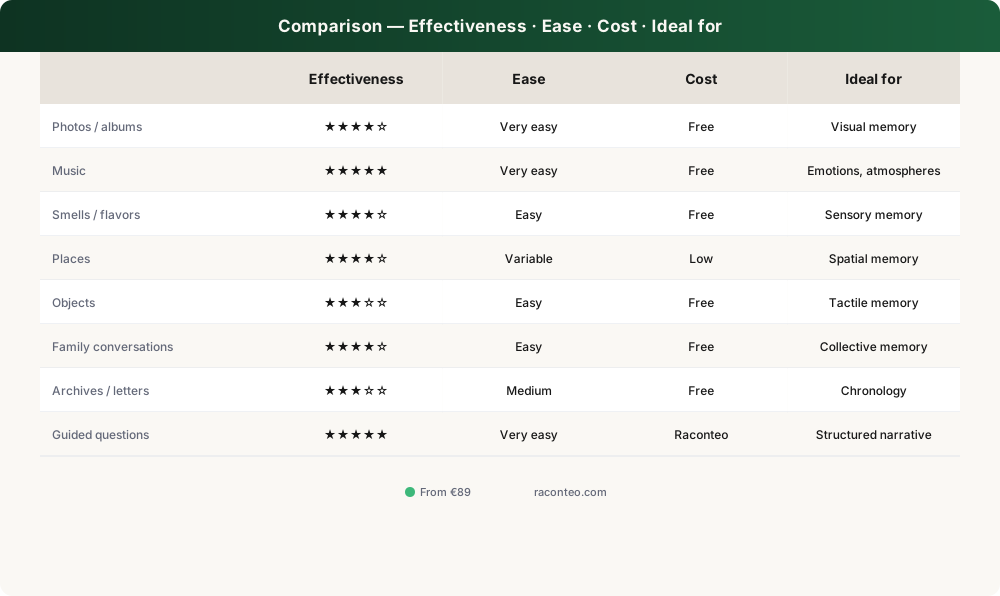
Trigger comparison table
| Trigger | Effectiveness | Ease | Cost | Ideal for |
|---|---|---|---|---|
| Photos / albums | ★★★★☆ | Very easy | Free | Visual memory |
| Music | ★★★★★ | Very easy | Free | Emotions, atmospheres |
| Smells / flavors | ★★★★☆ | Easy | Free | Sensory memory |
| Places | ★★★★☆ | Variable | Low | Spatial memory |
| Objects | ★★★☆☆ | Easy | Free | Tactile memory |
| Family conversations | ★★★★☆ | Easy | Free | Collective memory |
| Archives / letters | ★★★☆☆ | Medium | Free | Chronology |
| Guided questions | ★★★★★ | Very easy | Raconteo | Structured narrative |
Frequently asked questions
Can I write my memoirs if I only have fragmented memories? Absolutely. A fragmented life story is a literary form in its own right. Just embrace it: write what you remember, acknowledge the gaps, leave the blanks. These spaces have their own eloquence.
Are my memories reliable after 70 or 80 years? All memories are reconstructions, at any age. Memory isn't a recorder: it reinterprets with each recall. What matters in a life story is sincerity, not encyclopedic accuracy.
What if I confuse my own memories with stories others told me? This is very common. Family memory and personal memory blend together. You can indicate the source ("my mother often told me that…") without devaluing your story. These inherited stories are part of who you are.
How can I write my memoirs if I have trouble concentrating for long? Work in short sessions of 15 to 20 minutes. One question per session. Raconteo is designed for this pace: each question is short, precise, and an answer of just a few lines is enough. The AI then assembles everything into a flowing narrative.
Do I need to remember everything to write my memoirs? No. You don't need to remember everything. You need to remember something: a moment, a sensation, a person. From a single true memory, you can build an entire narrative.
Start with your memories of today
Raconteo asks the right questions to unlock your memories, even if you think you can't remember anything. Simple interface, extraordinary results.