Dictate your memoirs by voice: the ideal method for seniors (2026 guide)
You don't need to write to tell your life story. Discover how to dictate your memoirs by voice and easily turn your words into a beautiful book of memories.
Dictate your memoirs by voice: the ideal method for seniors (2026 guide)
You have a whole lifetime to share, a head full of memories, stories that deserve to be passed on — but the thought of sitting in front of a screen and typing it all out feels overwhelming? Good news: you don't need to write a single line. Dictating your memoirs by voice is a natural, accessible method that is often far more true to your personality than any text written from scratch.
This guide covers everything: why your voice is such a powerful tool for telling your life story, which tools to use, and how Raconteo turns your dictation into a real book of memories.
Table of contents
- Why speaking is more natural than writing
- The two main approaches
- Available tools
- Tips for dictating well
- Turning dictation into text
- Dictation vs other methods
- Raconteo and voice dictation
- Frequently asked questions
Why speaking is more natural than writing for sharing memories
When you share a memory out loud — with a friend, your grandchild, during a family dinner — the words come naturally. Your voice carries the emotion, the rhythm, the pauses. When writing, that spontaneity is often lost: you reread, correct yourself, doubt your writing skills.
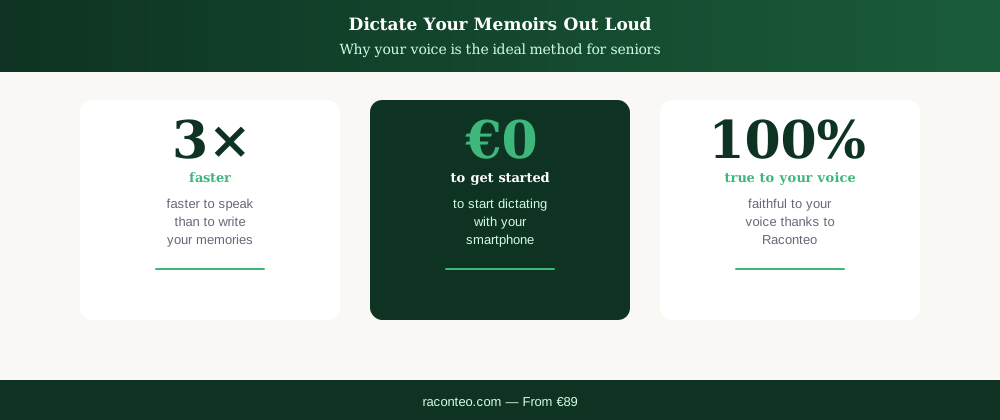
Research in narrative psychology confirms it: speech is 3 times faster than handwriting for expressing autobiographical memories. And above all, it's more authentic. Your accent, your expressions, your pauses charged with emotion — all of that is part of your story.
For seniors, voice dictation has an additional advantage: it bypasses the barriers associated with writing (spelling, typing, eyesight). It makes the memoir project accessible to everyone, regardless of educational background or digital skills.
Read also: Tell your life story without knowing how to write
The two main approaches: audio recording vs real-time dictation
1. Deferred audio recording
You record your voice — with your smartphone, a voice recorder, or even a simple voice memo — and have the audio transcribed afterwards. This approach is ideal if you prefer to speak freely, without looking at a screen. You can record in your living room, in the garden, during a walk.
Advantages: no real-time technical constraints, complete freedom of tone, ability to review and re-record.
Disadvantages: transcription step to handle afterwards, variable audio quality depending on the environment.
2. Real-time voice dictation
You speak and the text appears immediately on the screen — like dictation on a smartphone. This is the "dictate" function available on all modern devices (iPhone, Android, iPad).
Advantages: instant results, you see the text forming, no audio files to manage.
Disadvantages: requires an internet connection and some familiarity with the interface.
Available tools for dictating your memoirs
Your smartphone (free)
All recent smartphones have a built-in voice dictation feature. On iPhone, tap the microphone icon on the keyboard. On Android, same process. You can dictate directly into Notes, WhatsApp, or any application.
Cost: free. Ideal for getting started with no commitment.
A USB or Bluetooth microphone
For better audio quality, especially if you have a soft voice or are recording in a noisy environment, an entry-level microphone ($20-40) makes a big difference.
Transcription apps
Services like Otter.ai, Whisper (open source), or Descript can transcribe an audio file with remarkable accuracy — often above 95% for English.
Raconteo
Raconteo integrates voice dictation directly into the memoir creation process. You answer guided questions by speaking, and the platform structures, enhances, and formats your story automatically. It's the simplest solution if you want a professional result with no technical effort.
Tips for dictating your memoirs well
Choose a quiet place
Background noise is the enemy of transcription. Close the windows, turn off the television. A room with furniture (which absorbs echo) gives better results than a tiled kitchen.
Prepare a loose outline
No need for a precise script, but jot down 3-4 themes on a piece of paper before you start. "Primary school, my first job, our holiday home." This outline helps you avoid long hesitations and repeated "ums."
Speak as if you're telling someone
Imagine you're speaking to your grandchild or a close friend. This natural, warm register is exactly what will make your memoirs vivid and endearing.
Proofread and correct afterwards
Automatic transcription isn't perfect. Plan a proofreading session — ideally not right after the recording, but the next day, with fresh eyes.
Read also: How to write your memoirs — complete guide
How to turn dictation into structured text
Once your audio is recorded or your dictation is done, you have raw text: a stream of transcribed speech as-is, with repetitions, digressions, and perhaps a few transcription errors.
The next step is to structure this material: group anecdotes by theme, correct typos, add chapter titles, harmonize the style.
This is where artificial intelligence becomes invaluable. A good tool like Raconteo can take your raw transcription and transform it into a fluid, structured, and moving narrative — while preserving your voice and your way of expressing yourself.
Read also: Preserving the memories of elderly loved ones
Voice dictation vs handwriting vs word processing
| Criterion | Voice dictation | Handwriting | Word processing |
|---|---|---|---|
| Ease for seniors | ★★★★★ | ★★★☆☆ | ★★☆☆☆ |
| Naturalness of narrative | ★★★★★ | ★★★★☆ | ★★★☆☆ |
| Speed | ★★★★★ | ★★☆☆☆ | ★★★☆☆ |
| Final result | ★★★★☆ | ★★★☆☆ | ★★★★☆ |
| Startup cost | Free | Free | Varies |
Raconteo and voice dictation: how it works
Raconteo is designed for people who want to tell their life story without battling technology. Here's how voice dictation works on the platform:
- You receive a guided question — for example, "Tell me about your first day of school." Simple, concrete, to trigger the memory.
- You answer by speaking — directly in the interface, on your smartphone or tablet.
- The AI structures your story — it transforms your spoken answer into well-written text, in your style, that you can review and adjust.
- Your book takes shape — chapter by chapter, your memories come together into a book you can give to your loved ones or order in print.
Starting from $89, you get a printed book of your memoirs — without having typed a single line. See pricing
Read also: What to do in retirement? Write your memoirs
Frequently asked questions
Does voice dictation work well for English? Yes. Current speech recognition engines achieve 95 to 98% accuracy for standard English. Regional accents are increasingly well recognized. Plan a quick review to correct the rare errors.
Do I need special equipment to dictate my memoirs? No. Your smartphone is enough to get started. The built-in microphone on recent iPhones and Android devices gives excellent results in a quiet environment.
Are my recordings saved if I use Raconteo? Yes. All your voice responses and generated texts are saved in your secure personal space. You can access them at any time and make changes.
Can I combine dictation and writing on Raconteo? Absolutely. Some chapters lend themselves better to dictation (vivid anecdotes, dialogue), others to writing (dates, descriptions). You can freely mix both approaches.
How long does it take to dictate your complete memoirs? It depends on the desired length. A book of 80 to 100 pages generally requires 8 to 15 hours of dictation spread over several weeks — at your own pace, with no pressure.
Start telling your life story today
Your story deserves to be told — and you don't need to know how to write to do it. With Raconteo, you dictate, the AI structures, and your loved ones receive a real book of memories.