How to Start Writing Your Memoirs: 7 Techniques to Beat Writer's Block (2026)
Not sure where to begin with your memoirs? Discover 7 proven techniques to get started, overcome writer's block, and write your first memories today.
Table of Contents
- The biggest obstacle: writer's block
- 5 reasons we keep putting it off
- 7 techniques to get started
- Which memory should you start with?
- Opening lines that hook the reader
- Creating your first writing ritual
- Comparison table: getting-started methods
- Frequently asked questions
- Go for it: your memoirs are waiting for you
Anne-Charlotte Triplet — sociologist and co-founder of Raconteo. She has spent three years studying how families pass their memory on, and has guided several hundred memoir books. More about her.
You've been thinking about it for years. Perhaps even decades. You know you have a life worth telling, precious memories, lessons to pass on. And yet, the blank page stays blank. The cursor blinks. The silence weighs heavy.
73% of people who want to write their memoirs don't know where to begin. It's not a lack of material, nor a lack of talent. It's writer's block, that universal dread that affects great authors and ordinary witnesses of extraordinary lives alike.
The good news? There are proven techniques to get you started. This guide gives you seven. Pick just one, and begin tonight.
The biggest obstacle: writer's block
Why the blank page paralyzes us
Writer's block isn't a writing problem. It's a problem of perfectionism and expectations. We imagine our memoirs need to be perfect from the very first sentence, as polished as the books we've read, as well-structured as a finished novel.
That's an illusion. The first draft of any text is always imperfect. Professional authors know this. That's why they write drafts. Your first attempt doesn't need to be good. It just needs to exist.
The fear of not doing your life justice
Another source of paralysis: the fear of telling it wrong. Of betraying reality. Of hurting someone unintentionally. Of sounding pretentious. These fears are legitimate, but they shouldn't stop you from starting. You can refine, nuance, and cut later.
Know first that telling your life story without being a writer is perfectly possible. Literary talent is not a requirement. Authenticity is.
5 reasons we keep putting it off
1. "I don't have the time"
Retirement, grandchildren, activities. And yet, 15 minutes a day is enough to produce a complete book in six months. It's not a question of available time. It's a question of priority.
2. "My life isn't interesting enough"
Every life is a novel. Not because it's spectacular, but because it's unique. Your memories of the village school in the 1950s, the way you raised your children, your doubts and your proudest moments: no one else can bear witness in your place.
3. "I don't know where to start"
That's precisely what this guide is for. The short answer: start anywhere. With a memory that keeps coming back. With a photograph. With a question your loved ones have already asked you.
4. "I'm afraid of forgetting important things"
You will forget some things. That's inevitable. But what you do write down will have been lived, and that's infinitely more precious than silence. The benefits of writing your memoirs go far beyond the need to be exhaustive.
5. "I'll write it someday"
"Someday" is the enemy of memoirs. The more time passes, the more memories fade, the more people who could have confirmed your stories are gone. If you're thinking about it today, today is the right moment.
7 techniques to get started
1. Start with a story, not with the beginning
Don't try to start "at the beginning." Choose a specific, sensory, vivid memory (a short scene you can still see clearly in your mind) and tell it. Childhood, first experiences, an ordinary day that turned out to be extraordinary.
2. Start from a photograph
Open an old album. Choose a photo that moves you. Set it in front of you and answer these questions: Where are you? How old are you? What happened that day? Who are the people around you? What doesn't this photo show? In ten minutes, you have your first piece of writing.
3. Write about a significant date
Choose a date that matters in your life: your wedding, the birth of a child, a move, a loss, a victory. Write down everything you remember about that day. The concrete details. What the weather was like. What you were wearing. What you felt.
4. Write from a smell or a taste
Smell is the sense most directly connected to memory. Close your eyes and think of a scent from your childhood or youth. Your mother's cooking, wet grass, a perfume. Let the memory surface and write down everything it brings with it.
5. Recreate a memorable conversation
Do you remember a conversation that marked you? Advice from your father, a declaration, an argument that changed everything? Write that dialogue as best you can remember it. Reconstruct the context. Explain why those words mattered.
6. Describe a place from your past
Your childhood home, your first flat, the café where you used to meet your friends. Describe this place with all your senses, as if you were guiding someone who has never seen it. Places anchor stories in reality, and describing a place often brings back dozens of memories attached to it.
7. Answer a question from a loved one
Ask a child, a grandchild, or a friend: "What have you always wanted to know about my life?" Their question will be your first topic. It's also an excellent way to discover which parts of your life truly interest the people who love you. You'll find more ideas in our guide on autobiography question ideas.
Which memory should you start with?
A counterintuitive piece of advice: don't start with your birth.
Memoirs that begin with "I was born on..." are often the most laborious to write, and the least engaging to read. You don't remember your birth. So why start there?
Start instead with the most vivid memory you have. The one that comes back spontaneously when you think about your life. The one you've told a hundred times to your loved ones. That memory is vivid because it matters. And that's exactly why it belongs in your book.
Chronological order can come later, when you're organizing. While writing, always favour emotional momentum over calendar accuracy.
If you'd like to explore the question of structure further, our complete guide on how to write your memoirs walks you through it step by step.
Opening lines that hook the reader
The first sentence is the hardest and the most important. It should make the reader want to read the next one. Here are a few templates that work:
The in medias res opening (in the middle of the action):
"It was a Tuesday in November 1962, and my father had just come home with a suitcase."
The sensory opening:
"I can still remember the smell of burning wood and bread warming, that morning."
The question opening:
"Why did I leave everything behind at thirty to start over from scratch?"
The paradox opening:
"The happiest day of my life began as the most ordinary."
These openings share one thing: they immediately place the reader in a specific context and make them want to understand what comes next. You can adapt them to your own story.
Creating your first writing ritual
Writing your memoirs isn't a sprint: it's a gentle marathon. To keep going over time, you need a ritual.
The 15-minute principle
Fifteen minutes a day is enough. No need for a marathon writing session at the weekend. That kind of intensive effort exhausts and discourages. Fifteen regular minutes is roughly 250 words a day, or a 200-page book in six months.
A dedicated space
Choose a place where you feel comfortable and won't be disturbed. Your desk, a particular armchair, the kitchen after breakfast. What matters is that this place becomes mentally associated with writing, like a signal for your brain.
The same time every day
In the morning, before the day sweeps away your focus. Or in the evening, as a ritual for reflection. The exact time matters less than consistency. Within a few weeks, the habit forms on its own.
A special object
A particular notebook, a favourite pen, a cup of tea. These small material rituals create a transition between daily life and writing. They signal to your mind: "it's time."
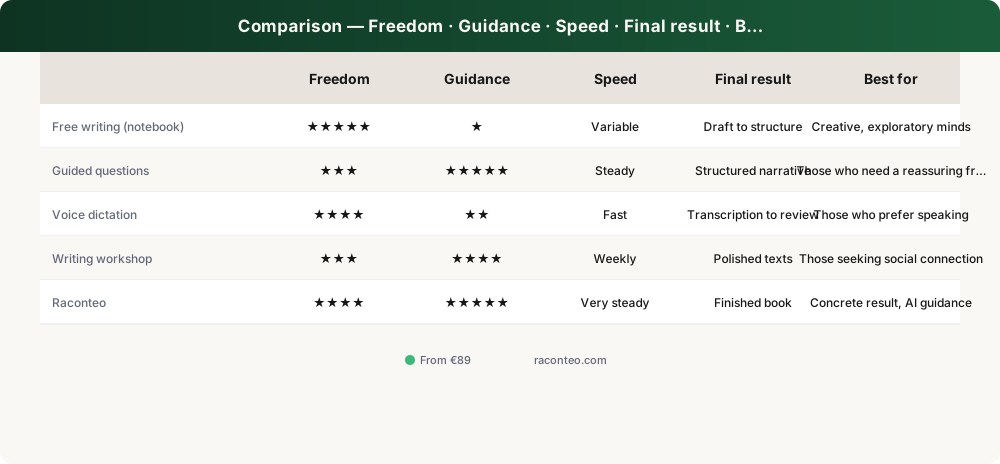
Comparison table: getting-started methods
| Method | Freedom | Guidance | Speed | Final result | Best for |
|---|---|---|---|---|---|
| Free writing (notebook) | ★★★★★ | ★ | Variable | Draft to structure | Creative, exploratory minds |
| Guided questions | ★★★ | ★★★★★ | Steady | Structured narrative | Those who need a reassuring framework |
| Voice dictation | ★★★★ | ★★ | Fast | Transcription to review | Those who prefer speaking |
| Writing workshop | ★★★ | ★★★★ | Weekly | Polished texts | Those seeking social connection |
| Raconteo | ★★★★ | ★★★★★ | Very steady | Finished book | Concrete result, AI guidance |
With Raconteo, each session is guided by themed questions. You answer at your own pace (by typing or speaking) and the AI turns your answers into smooth, moving narratives. No need to know how to write. No need to structure anything. Just bring your memories.
Frequently asked questions
Do I have to write in chronological order?
No, and it's often not recommended when starting out. Chronological order is a constraint that blocks more than it guides. Start with your most vivid memory, wherever it falls in your life. You can rearrange everything when you're doing the final edit.
How long does it take to write your memoirs?
With 15 minutes a day, you can produce a 150- to 200-page book in six months. With a weekly one-hour session, expect one to two years. What matters isn't speed, but consistency. Even an unfinished account is a priceless gift for your loved ones.
Should I reread and correct as I go?
No. During the writing phase, write without rereading. Editing and correcting come afterwards. If you stop every sentence to fix it, you risk losing your thread and getting discouraged. Let it flow, imperfectly, freely. The polish comes later.
Can I mix my own memories with stories my family told me?
Yes, as long as you make it clear. You can easily write: "According to what my mother told me..." or "My brother remembers that..." These cross-referenced accounts enrich the narrative and give it a valuable collective dimension. It's actually one of the most natural ways to write your family history.
What if I write a few pages and then stop for weeks?
It happens to almost everyone. Don't feel guilty. Simply reread what you've written: reading your own words is often the best trigger to start again. And if you find it hard to keep momentum on your own, a guided tool like Raconteo can send you reminders and questions to help you get back on track.
Go for it: your memoirs are waiting for you
The first sentence is always the hardest. After that, it flows. Memories call up other memories, details sharpen, and the pleasure of storytelling overtakes the fear of getting it wrong.
Your loved ones aren't expecting a literary masterpiece. They want your voice, your memories, your life. Who you are. What you lived through. What you want to pass on to them.
Raconteo supports you every step of the way: from the first guided questions to the printed book in your hands. Discover our complete guide to writing your memoirs, explore our pricing, and get started today.