Writing an elderly person's biography: a guide to preserving their memories before it's too late
How to write the biography of an elderly parent or grandparent? Practical guide to collecting their memories, even in a care home or with cognitive decline. Act now.
Table of contents
- The urgency: why you shouldn't wait
- Signs it's time to act
- How to bring up the subject with an elderly parent
- The step-by-step method for writing an elderly person's biography
- Adapting the approach to the situation
- Tools suited to seniors
- What the biography brings to the senior themselves
- Comparison of biography methods
- Frequently asked questions
Anne-Charlotte Triplet — sociologist and co-founder of Raconteo. She has spent three years studying how families pass their memory on, and has guided several hundred memoir books. More about her.
Your father is 82. Every Sunday, he tells the same story: the day he met your mother at the village dance. You've heard it a hundred times. You smile, you nod, but you've never taken the time to write it down. One day, he won't be able to tell it any more. And that day, you'd give anything to hear it one last time.
Writing an elderly person's biography isn't a whim. It's an act of urgency. Every week that passes carries away details, names, fragments of life that nobody else can ever restore. This guide gives you all the keys to collect an elderly person's memories, methodically, respectfully, and before it's too late.
Whether your parent is independent at home, in a care home or showing signs of cognitive decline, there's an approach that fits. And no, you don't need to know how to write to tell your life story.
The urgency: why you shouldn't wait
Every day counts, literally
An elderly person's biography is a race against time. That's not a dramatic turn of phrase: it's a statistical reality. Behind every passing, decades of stories, lessons, vivid memories vanish forever.
The generation born between 1930 and 1955 lived through pivotal eras: the war, reconstruction, the post-war boom, social upheavals, the arrival of television, the rural exodus. They are the last witnesses of a world that no longer exists. When the last witness in a family is gone, an entire library burns.
Memory fades before life does
It's not enough for your parent to be alive for their memories to be accessible. Cognitive decline begins well before medical diagnoses. By 75, episodic memory, the memory of personal events, is already weakening. By 85, many seniors lose the ability to construct a coherent narrative, even if they retain flashes of memory.
Writing an elderly person's life requires faculties that time erodes: the ability to recall details, organize them chronologically, tell them with emotion. These faculties may not be there in two years. Or even in six months.
Ribot's gradient: a window of opportunity
There's good news, however. Neuroscience has demonstrated it with Ribot's temporal gradient: the oldest memories are the last to disappear. An octogenarian who can't remember what they did yesterday can describe with striking precision their first day of school, the smell of bread in their village bakery, or the sound of hooves on cobblestones.
These elderly person's memories are intact, ready to be collected. But they won't remain so forever. Every day without action is a day when details fade. Now is the time to act to capture your elders' memories.
Signs it's time to act
How do you know if the moment has come to collect an elderly person's testimony? Here are the warning signs. If even one resonates, it's already time:
- They often repeat the same stories. It's not senility but a need to pass things on. They're handing you a treasure. Take it.
- They're starting to confuse dates or names. Memory is beginning to falter. What's still clear today will be blurry tomorrow.
- They're the last of their siblings or generation. When they're gone, nobody can take over.
- They live in a care home. Isolation accelerates memory decline. A biography in a care home is a way to restore meaning.
- They're approaching a symbolic milestone: 80, 85, 90. These birthdays are natural triggers.
- A cognitive disorder diagnosis has been made. Even mild, it's an alarm signal. Biography and Alzheimer's aren't mutually exclusive, but every month counts.
- They express regrets: "Nobody cares about all this," "In my day..." They want to talk. They're just waiting to be asked.
- You've already lost another parent without collecting their story. You know that regret. Don't live it again.
Don't wait for the perfect moment. The perfect moment is now.
How to bring up the subject with an elderly parent
The first step is the hardest
Suggesting to a parent that they write their biography can feel delicate. Many seniors respond: "My life isn't interesting." That's false, of course, but this response reflects a genuine modesty that must be respected.
Here's how to approach the subject without putting your parent off:
Don't say "biography." The word can intimidate. Say instead: "I'd love you to tell me what it was like when you were little" or "The children asked me how people lived before." Root the approach in family transmission, not in a literary project.
Start with a specific question, not "Tell me about your life." Ask: "Do you remember your childhood home?" or "Is it true that grandpa worked in the mine?" A concrete question opens a door. An abstract one closes it.
Acknowledge what they've already shared. "The other day, you talked about grandma's garden. I'd love to know more, and I'd like your grandchildren to know that story too."
Mention the grandchildren. This is the most powerful lever. Most seniors refuse to talk for their own sake, but happily agree to pass things on for their grandchildren.
What you absolutely must not do
- Never say: "We need to do this before it's too late." Even if it's true, it's harsh.
- Don't push. If your parent refuses, wait a week and come back from a different angle.
- Don't pull out a notebook and pen at the first conversation. Let the words come naturally.
- Don't interrupt to correct dates or details. What matters isn't historical accuracy but the lived experience.
The step-by-step method for writing an elderly person's biography
Step 1: Prepare the groundwork
Before you start collecting an elderly person's memories, some preparation is in order.
Gather family photos. Nothing triggers memory as effectively as an old photo. Scan them if necessary, or bring the physical albums. Photos are the best trigger for an oral biography.
List the main periods of their life. Childhood, school, first job, military service, marriage, children, retirement. No need to be exhaustive: it's a guiding thread, not an interrogation.
Prepare open-ended questions. Not "Did you like school?" (answer: yes/no) but "What was school like in your day?" For inspiration, check our guide for interviewing your grandparents.
Choose the right moment. Elderly people are often most alert in the morning. Avoid times of fatigue, medical visit days, periods of anxiety. Short sessions (30 to 45 minutes) are more productive than marathons.
Step 2: Interview with kindness
On the day, your role is simple: listen. Not guide, not correct, not constantly prompt. Listen.
Record if possible. A phone placed on the table is enough. Your parent's voice is a treasure in itself. Ask permission, but most seniors agree without issue when you explain it's "for the grandchildren."
Follow their train of thought. Your parent won't tell their life chronologically. They'll jump from one era to another, go back, digress. Let them. A senior's life story has its own logic: that of emotion, not the calendar.
Prompt gently. "And then?", "How did you feel?", "What did that village look like?" Sensory questions (smells, sounds, colours) are the most effective at stimulating ancient memory.
Welcome emotions. There will be laughter and perhaps tears. That's normal. It's even precious. Don't try to cut short. An elderly person's testimony is charged with emotion, and that's what makes it irreplaceable.
Do several sessions. Don't try to cover everything at once. Four to six sessions of 30-45 minutes are ideal. Space them a week apart to let memory work between sessions. Your parent will often remember new details between appointments.
Step 3: Write and structure the narrative
This is often the step that blocks. Transforming hours of conversation into a readable, moving text takes time, patience and some writing skill. Three options are available:
Do it yourself. If you enjoy writing, it's a magnificent project. Transcribe the recordings, organize by themes or periods, keep the oral tone: your parent's expressions, turns of phrase, humour. That's what brings a senior biography book to life. Allow 40 to 80 hours of work.
Hire a professional biographer. Writers specializing in life narratives offer this service. Expect €3,000 to €8,000 depending on length and complexity. A significant investment, but a professional result.
Use an AI-assisted writing tool. Platforms like Raconteo let you create a biography from answers to guided questions, with automatic AI writing. At €89, it's the most accessible option for writing an elderly parent's biography without literary skills.
Step 4: Reread together and complete
This step is crucial, and often the most moving. Reread the narrative with your parent. It's a moment of validation, but above all a moment of connection.
Your parent will correct details, add forgotten anecdotes, marvel at seeing their life put into words. "Is that really me, all this?" is a phrase you'll probably hear.
Use this rereading to fill gaps. The questions you didn't ask, the periods skimmed over, the people mentioned without context. It's often during rereading that the most intimate memories emerge, those your parent hadn't dared share the first time.
Adapting the approach to the situation
The elderly person independent at home
This is the ideal situation. Your parent is at home, surrounded by their belongings, photos, memory objects. The familiar environment naturally aids memory recall.
Tip: suggest regular sessions, like a ritual. "Every Wednesday afternoon, we have tea and you tell me a bit of your life." This reassuring, predictable framework lets the senior mentally prepare and retrieve memories between sessions.
The elderly person in a care home
A biography in a care home has its specifics. Your parent lives in an environment that isn't their own, away from their landmarks. But this context also has an advantage: the care staff are often valuable allies.
Tip: bring photos, personal objects, period songs. Sensory anchoring compensates for the absence of the familiar environment. Inform the staff about your project, because many care homes actively encourage reminiscence therapy and can help you.
Sessions should be shorter (20-30 minutes) and more frequent. Adapt to your parent's rhythm, not your schedule.
The person with cognitive impairment or Alzheimer's
Creating a biography with Alzheimer's is possible, but the approach must be profoundly adjusted. Ancient memories are often preserved: it's recent memory that's affected first. Your 85-year-old parent with Alzheimer's may remember their childhood better than last week.
Keys to success:
- Favour sensory memories. "What did you smell when you came home to your mother's?", "What sound did your father's tractor make?" The senses are powerful gateways to deep memories.
- Use triggers. Photos, period music, familiar objects. A song from the 1950s can awaken a flood of memories that no direct question would have elicited.
- Accept disorder. The narrative won't be linear. It will be fragmented, repetitive, sometimes incoherent. That's fine. Every fragment is a treasure.
- Never correct. If your parent places a memory at the wrong date, don't rectify. What matters is what they feel, not factual accuracy.
- Keep sessions very short (15-20 minutes) and stop as soon as fatigue or agitation appears.
Stories collected from a parent with cognitive impairment are often strikingly beautiful: raw, emotional, stripped of all artifice.
The person at end of life
This is the most delicate and most urgent situation. When a parent is at end of life, time is measured in days or weeks. Every conversation may be the last.
The approach must be gentle and pressure-free. Don't ask for a structured narrative. Ask a single question: "What is your most beautiful memory?" or "What would you want your grandchildren to know about you?" A single answer can be enough to create a legacy.
Record the voice. Even a few minutes. The voice of a departed parent is the most poignant memory a family can keep.
Don't apologize for asking. You're not imposing anything. You're offering an opportunity to pass something on. Most people at end of life wish to leave a trace. Give them this chance.
Tools suited to seniors
The technology problem
The majority of seniors over 80 are not comfortable with technology. Asking them to type on a keyboard, navigate a complex app or "create an account" is often a dealbreaker.
That's why tools designed to write an elderly person's life must meet precise criteria:
- Radical simplicity. No complex menus, no 20-minute tutorials.
- Voice dictation. Speaking is more natural than writing for most seniors. Oral biography captured via voice dictation is the least intimidating method.
- Guided questions. Instead of a terrifying blank page, thematic questions that open the floodgates of memory.
- Readability. Large fonts, strong contrasts, clean interface.
Raconteo: designed for seniors and their families
Raconteo was built for exactly this use case. The platform offers:
- Guided thematic questions: childhood, school, career, love, family, travel. No need to know where to start: Raconteo asks the right questions in the right order.
- Built-in voice dictation: your parent speaks, the tool transcribes. Ideal for those who can't or can no longer write. Discover how to tell your life story without writing.
- AI-assisted writing: from raw answers, artificial intelligence generates a fluid, personal narrative in your parent's style.
- A printed book: the end result is a real book, with cover, chapters and photos. A tangible object to give to the whole family.
- An accessible price: €89, it's the most affordable way to create a quality senior biography. Far from the €3,000 to €8,000 of a private biographer.
Raconteo is also a perfect gift for a parent or grandparent. Giving someone the opportunity to tell their life is saying: "Your story matters."
Family collaboration
An often underestimated advantage: the whole family can participate. With Raconteo, children, grandchildren or close friends can suggest questions or supplement answers. You can interview your parent during a care home visit and enter their answers in the evening from home.
This collaborative dimension is essential for geographically scattered families. Even a grandchild living abroad can contribute by asking a question the grandparent will receive during their next session.
What the biography brings to the senior themselves
Reminiscence therapy
People often think an elderly person's biography is a gift for the family. That's true. But it's also, and perhaps above all, a gift for the senior themselves.
Reminiscence therapy is a clinically validated approach, used in many care homes and Alzheimer's units. Its principle is simple: stimulate ancient memories to improve psychological well-being.
Studies show that seniors who practise structured reminiscence display:
- Fewer depressive symptoms. Remembering good times revives positive emotions.
- An increased sense of dignity. "My life mattered. My story deserves to be told."
- Better self-esteem. By rereading or hearing their story, the senior becomes aware of everything they've accomplished.
- Strengthened social bonds. The biographical project creates opportunities for conversation, sharing, complicity with loved ones.
To learn more about these effects, read our article on the benefits of memoir writing for seniors.
Giving meaning to the final years
Many elderly people go through what psychologists call the "integrity crisis", that moment when you look back to assess whether your life had meaning. Biography is a powerful tool for resolving this crisis positively.
By putting their life into narrative, the senior shifts from "I'm nothing any more" to "I lived extraordinary things." This shift is profound. It transforms the final years of a life into an act of transmission, not a passive wait for the end.
The pleasure of storytelling
Let's not forget the essential: telling your life story is enjoyable. For many isolated seniors, the biographical project becomes the highlight of the week. "When do we start again?" they ask after each session. A senior's life story is an activity that stimulates, engages, gives a reason to get up in the morning.
Comparison of biography methods
| Criterion | Writing yourself | Private biographer | Raconteo |
|---|---|---|---|
| Price | Free (your time) | €3,000 - €8,000 | €89 |
| Time investment | 40-80 hours | 10-15 hours (interviews) | 5-10 hours |
| Skill required | Advanced writing | None | None |
| Voice dictation | No | No (but recorded) | Yes, built-in |
| Suited to cognitive impairment | Difficult | Yes (trained professional) | Yes (guided questions) |
| Printed book result | Self-organized | Yes | Yes |
| Family participation | Variable | Limited | Yes (built-in collaboration) |
| Timeline | 3-12 months | 3-6 months | 2-8 weeks |
| Personalization | Total | High | High (adjustable style) |
| Accessible for a senior alone | Difficult | No (needs appointments) | Yes (autonomous with dictation) |
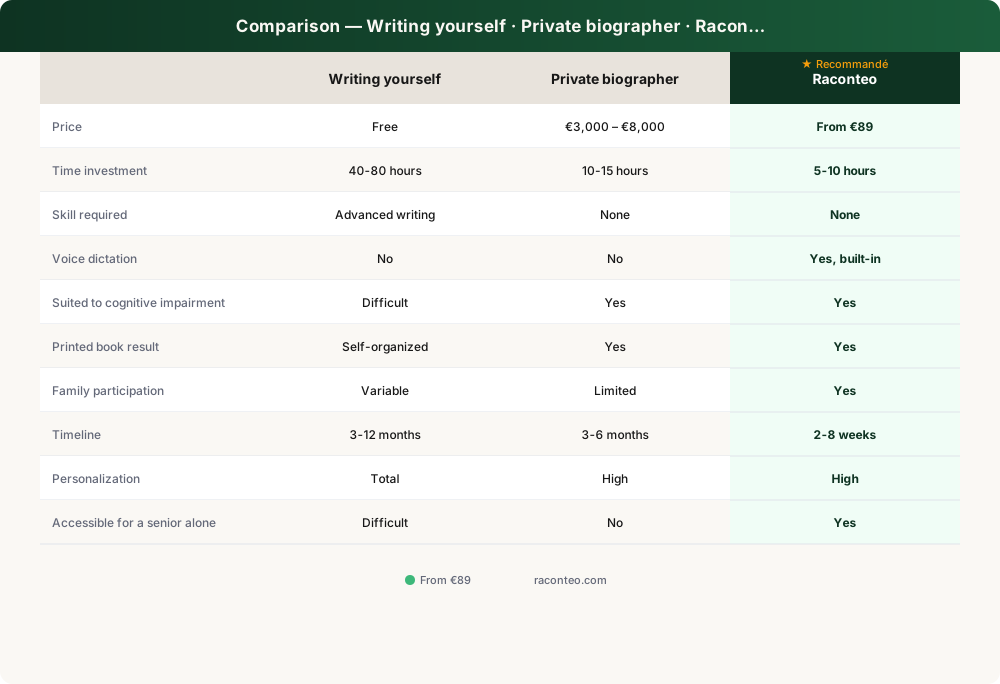
For a more detailed comparison between approaches, read our guide on how to have your biography written.
Frequently asked questions
Is it possible to write the biography of a person with Alzheimer's?
Yes, and it's even recommended. A biography with Alzheimer's is possible because ancient memories are the last to disappear. The method must be adapted: short sessions, sensory triggers (photos, music, objects), acceptance of chronological disorder. Every fragment collected is precious. Reminiscence therapy professionals use this approach in care homes with remarkable results on patient well-being.
My parent says their life isn't interesting. How do I convince them?
It's the most common response, and the most false. Every life is extraordinary when you take the time to listen. Don't say "Your life is interesting" (they won't believe you). Say instead: "Your grandchildren want to know what it was like before" or "Nobody else can tell this. You're the only one who lived it." The angle of transmission to future generations is the most effective.
How long does it take to complete a full biography?
It depends on the method chosen. If you do it yourself, allow 40 to 80 hours spread over several months. With a professional biographer, 10 to 15 hours of interviews over 3 to 6 months. With Raconteo, the process can be completed in 2 to 8 weeks with only 5 to 10 hours of answering. In all cases, don't rush: the senior's pace must be respected.
How do I proceed if my parent lives far away?
Distance isn't an insurmountable obstacle. You can conduct interviews by phone or video call. With Raconteo, you can even send questions to your parent and receive their answers remotely, via voice dictation if they prefer speaking to writing. Built-in family collaboration lets everyone contribute from anywhere.
Should you verify the accuracy of memories?
No, at least not initially. The goal of an elderly person's biography isn't to produce a certified historical document. It's to capture an experience, emotions, a personal perspective. If your parent places an event in 1962 when it was 1964, what matters is what they felt, not the exact date. You can refine factual details during proofreading, with delicacy.
Can you create a biography in a care home?
Absolutely. Many care homes encourage this type of project, which fits within the reminiscence therapy approach. Notify the care staff, who can tell you the best times for sessions and sometimes even participate. Bring photos and personal objects to compensate for the absence of the familiar environment. A biography in a care home is often one of the most rewarding projects for the resident.
What if my parent refuses to talk about certain periods?
Respect their silences. A life sometimes contains painful episodes: war, bereavement, breakup, family secrets. Never force. You can return to the subject later, from a different angle, but if the refusal persists, accept it. A parent's biography doesn't need to be exhaustive to be precious. Even a partial narrative is infinitely better than no narrative at all.
When is the best time to start?
Now. Not "when I have time." Not "this summer, when the kids are on holiday." Not "for their 90th birthday." Now. Every passing day is a day when memories fade, energy declines, the window narrows. An elderly person's life story cannot wait for your schedule.
Don't wait: every day counts
You've read this article to the end. That means you know, deep down, that it's time to act. That your parent, your grandfather, your grandmother has a life story that deserves to be preserved. That you don't want to join the millions of people who say "I should have" when it's too late.
Writing an elderly person's biography has never been simpler. You don't need to know how to write. You don't need a large budget. You don't need unlimited free time.
You need to start. Today.
Three things you can do in the next 24 hours:
- Call your parent. Ask them a single question: "Do you remember your first day of school?" And listen.
- Gather the photos. Get the album out, scan the pictures, prepare the memory triggers.
- Launch the project. Create an account on Raconteo or give it as a gift. For €89, you give your parent the chance to pass on their story, and your family a treasure that will cross generations.
Every passing day is one day less. Don't let your loved ones' memories disappear in silence. Act now: for them, for you, for those who will come after.
Have questions about the process? Check our full FAQ or discover how to preserve elderly people's memories with the right tools.