Comparison: the best software for creating a memoir book in 2026
Overview of the best solutions for creating a memoir or family biography: Raconteo, StoryWorth, Memoir, Canva, Word... Features, prices, target audience.
You want to preserve the life story of someone you love, but faced with the multitude of tools available, it can be hard to know where to start. Should you use a specialist service? A standard word processor? A genealogy app?
This comparison will help you find the most suitable solution for your situation.
Contents
- The main categories of tools
- Specialist memoir services
- General-purpose solutions
- Summary comparison table
- Our recommendation by profile

Anne-Charlotte Triplet — sociologist and co-founder of Raconteo. She has spent three years studying how families pass their memory on, and has guided several hundred memoir books. More about her.
The main categories of tools
There are three broad approaches to creating a memoir book:
- Specialist services: designed specifically for memoirs and family biographies (Raconteo, StoryWorth…)
- General-purpose tools: word processors (Word, Google Docs) or self-publishing tools (Canva, Blurb)
- Genealogy software: MyHeritage, Ancestry, which sometimes include storytelling features
Specialist memoir services
Raconteo ⭐ Recommended if you are writing in English
Target audience: English-speaking families, people aged 60 and over, projects of 4 to 8 weeks
Raconteo is a platform available in five languages (English among them) designed to create AI-guided memoir books. The person answers thematic questions (by voice or in writing), and the AI transforms the responses into coherent narrative chapters.
Strengths:
- 100% in English, adapted for senior users
- Interface and question playlists available in 5 languages (English, French, Spanish, Italian, German)
- Built-in voice input
- Narrative AI that preserves the person's voice
- Printing in France (10-15 days)
- Free trial available (up to 3 stories)
Weaknesses:
- Requires an internet connection
Price: Free trial (up to 3 stories) | €89 (1 copy included) | +€39/additional copy
StoryWorth
Target audience: English speakers, 12-month projects
StoryWorth sends one question per week by email to your loved one. At the end of the year, the responses are compiled into a book. Simple and popular in the United States, but entirely in English.
Strengths:
- Simple concept, easy to adopt
- Varied and well-crafted questions (in English)
- Quality hardbound book
Weaknesses:
- English only: unsuitable for non-English-speaking families
- No AI rewriting: the book compiles raw responses
- Delivery from the United States (long delays for UK and Europe)
- No free plan
Price: ~$99/year (book included) + international delivery charges
Memoir (formerly Lifeograph)
Target audience: English speakers, personal journals and memoirs
Memoir is a mobile journalling app with a book compilation feature. Less structured for biographies, more oriented towards personal diaries.
Strengths:
- Polished mobile interface
- Good daily experience
Weaknesses:
- English only
- No narrative guidance through questions
- Variable print quality
Price: Subscription ~$30/year
General-purpose solutions
Word / Google Docs + print service
Target audience: tech-comfortable users who want full control
The DIY solution: write the text in Word or Google Docs, add photos manually, then send the file to a printer (Blurb, Lulu, Bookinabox…).
Strengths:
- Full control over content and layout
- Can look excellent with care and effort
- Competitive print prices if you do everything yourself
Weaknesses:
- Requires time and skills (layout, writing)
- No guidance for structuring memories
- The person must write everything themselves, a barrier for non-writers
- Result varies greatly depending on the author's ability
Price: £0 (writing) + £20-50 printing depending on service
Canva
Target audience: creative individuals, highly visual books
Canva offers photo book and illustrated story templates. Excellent for a visually led book, less suited for a narrative book centred on text.
Strengths:
- Visually beautiful templates
- Easy to get started
- Quality printing
Weaknesses:
- Not designed for memoirs: no guided questions
- Writing remains entirely the author's responsibility
- Some features not fully localised
Price: Free (limited) | ~£100/year (Pro) | print on demand
MyHeritage / Ancestry
Target audience: genealogy enthusiasts
These platforms allow you to build family trees and export "family history books" from tree data. Very useful for genealogy, less so for personal memoirs.
Strengths:
- Family tree integration
- Access to historical archives
- Good for telling a family story across multiple generations
Weaknesses:
- Focused on facts (dates, places, names) rather than personal narratives
- Less suited to capturing emotions, anecdotes and the personality of a loved one
- Costly subscriptions
Price: £80-250/year depending on plan
Summary comparison table
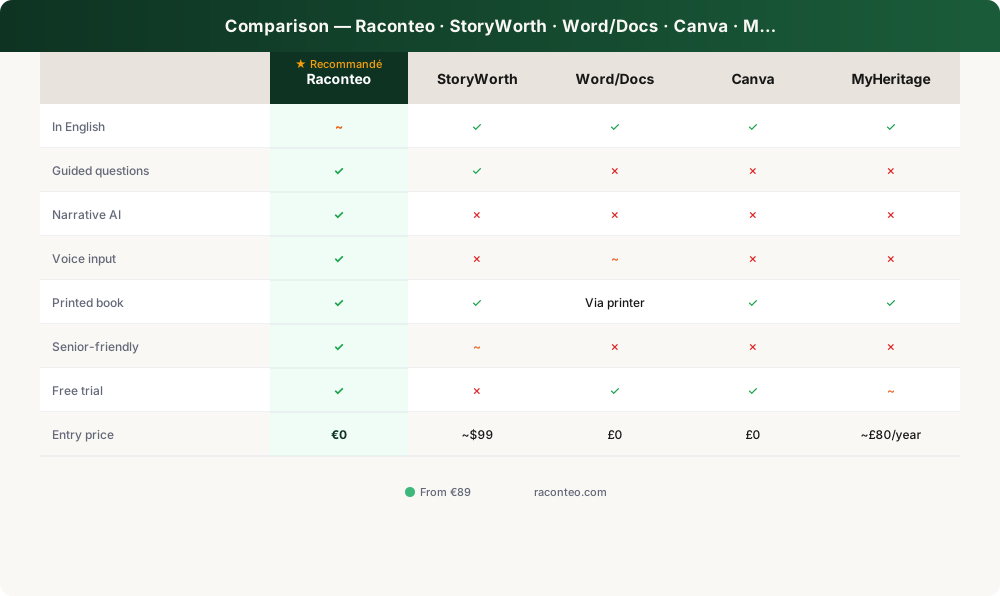
| Raconteo | StoryWorth | Word/Docs | Canva | MyHeritage | |
|---|---|---|---|---|---|
| In English | ✅ | ✅ | ✅ | ✅ | ✅ |
| Guided questions | ✅ | ✅ | ❌ | ❌ | ❌ |
| Narrative AI | ✅ | ❌ | ❌ | ❌ | ❌ |
| Voice input | ✅ | ❌ | ⚠️ | ❌ | ❌ |
| Printed book | ✅ | ✅ | Via printer | ✅ | ✅ |
| Senior-friendly | ✅ | ⚠️ | ❌ | ❌ | ❌ |
| Free trial | ✅ | ❌ | ✅ | ✅ | ⚠️ |
| Entry price | €0 | ~$99 | £0 | £0 | ~£80/year |
Our recommendation by profile
You want a structured journey and a finished book within a few weeks → Raconteo. Guided themed questions, narrative AI and voice input: the text takes shape as the story is told.
You prefer a slow pace, one question a week over a full year, and you are happy to write the answers yourself → StoryWorth, provided you accept the yearly subscription and delivery from the United States.
The person telling the story writes with difficulty, or tires quickly at a keyboard → Raconteo, for the voice input: they simply speak, and the AI handles the writing.
You are passionate about genealogy and want an enriched family tree → MyHeritage or Ancestry alongside Raconteo for the personal narratives.
You enjoy DIY and have the time → Word + printer: the cheapest option, if you or your loved one are comfortable writing and laying out pages.
You want a highly visual book → Canva as a complement, but Raconteo remains the best tool for structuring the stories themselves.
If your shortlist really depends on what is comfortable to use on a tablet or a phone, our memoir writing app comparison weighs up the same tools from that angle.
For families who want to capture a loved one's life story, without spending months on it and without paying thousands, Raconteo is the most complete and most accessible solution available in 2026.